+86 18513032986


Types of Circuit Breakers: A Complete Guide
Admin 2026-03-30Content
- 1 How Circuit Breakers Work Before Diving Into Types
- 2 Standard Thermal-Magnetic Circuit Breakers
- 3 Magnetic-Only Circuit Breakers
- 4 Thermal-Only Circuit Breakers
- 5 Ground Fault Circuit Interrupter (GFCI) Breakers
- 6 Arc Fault Circuit Interrupter (AFCI) Breakers
- 7 Dual-Function AFCI/GFCI Breakers
- 8 Single-Pole vs. Double-Pole vs. Three-Pole Circuit Breakers
- 9 Molded Case Circuit Breakers (MCCBs)
- 10 Insulated Case Circuit Breakers (ICCBs)
- 11 Air Circuit Breakers (ACBs)
- 12 Vacuum Circuit Breakers (VCBs)
- 13 SF₆ Gas Circuit Breakers
- 14 High-Voltage DC (HVDC) Circuit Breakers
- 15 Miniature Circuit Breakers (MCBs)
- 16 Comparing Circuit Breaker Types at a Glance
- 17 Key Factors When Selecting a Circuit Breaker
- 18 Common Mistakes When Working With Circuit Breakers
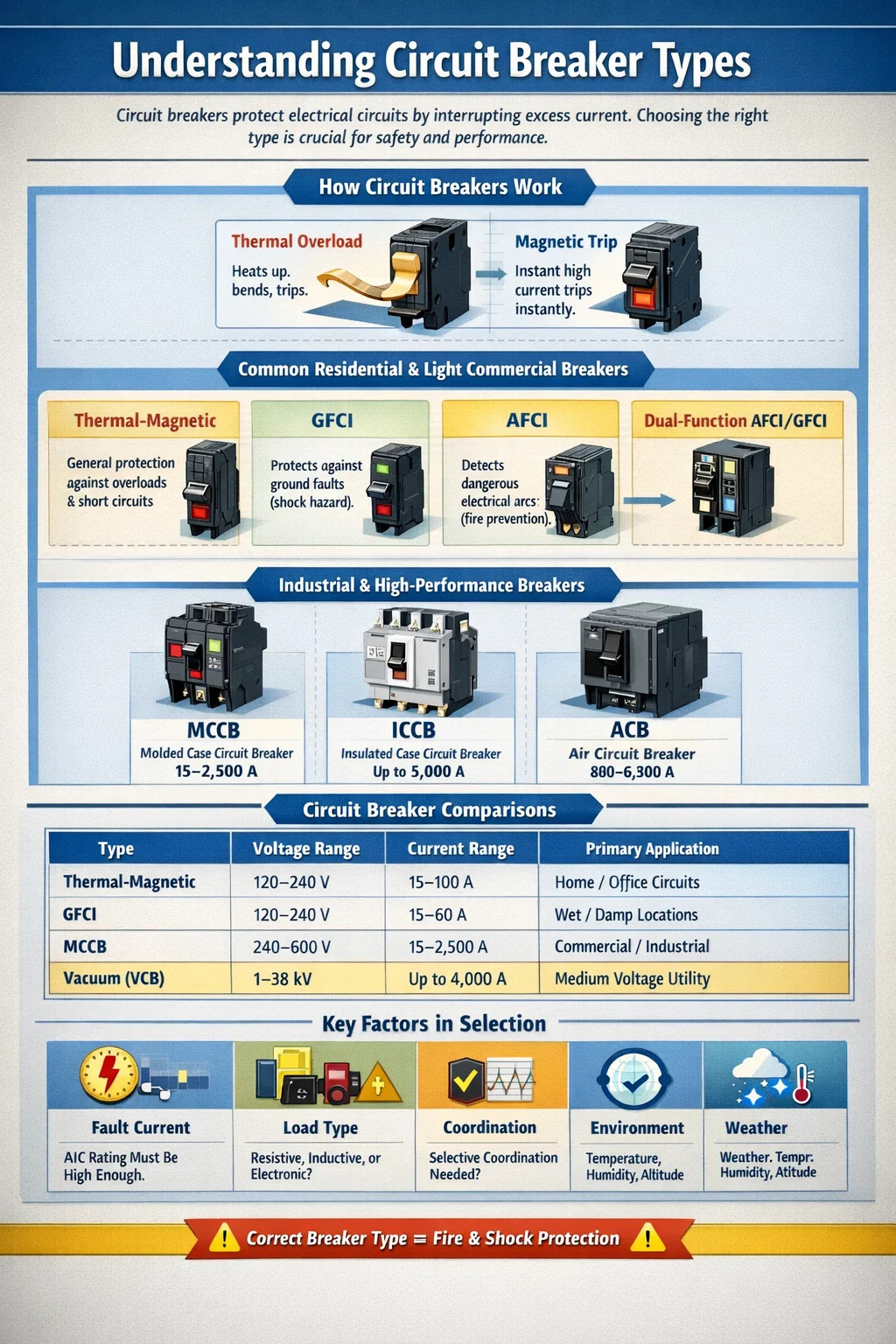
Circuit breakers are automatic electrical switches designed to protect circuits from damage caused by overcurrent, short circuits, or ground faults. There are six primary types of circuit breakers: standard (thermal-magnetic), magnetic-only, thermal-only, ground fault circuit interrupter (GFCI), arc fault circuit interrupter (AFCI), and dual-function (AFCI/GFCI) breakers — each engineered for a specific protection scenario. Beyond these residential and light commercial categories, industrial environments rely on molded case circuit breakers (MCCBs), insulated case circuit breakers (ICCBs), and air circuit breakers (ACBs). Choosing the wrong type can leave equipment unprotected or trigger nuisance tripping; choosing the right one can prevent fires, electrocution, and costly downtime.
How Circuit Breakers Work Before Diving Into Types
Every circuit breaker monitors current flow and interrupts it when something abnormal is detected. The detection mechanism — whether bimetallic strip, electromagnet, electronic sensor, or a combination — determines what hazards the breaker can catch and how quickly it responds. A breaker rated at 20 A will trip when current consistently exceeds that threshold, but the trip time varies dramatically depending on the technology inside. Understanding this basic principle makes the differences between types much easier to grasp.
The interrupting capacity — often written as AIC (Ampere Interrupting Capacity) — tells you the maximum fault current the breaker can safely interrupt. Residential breakers commonly carry 10,000 AIC ratings; industrial breakers can exceed 200,000 AIC. Ignoring this figure is a common and dangerous mistake.
Standard Thermal-Magnetic Circuit Breakers
The thermal-magnetic circuit breaker is the most common type found in residential load centers and light commercial panels worldwide. It uses two separate mechanisms working in tandem, which gives it the flexibility to handle both sustained overloads and instantaneous short circuits.
Thermal Element: Slow-Response Overload Protection
The thermal element is a bimetallic strip made from two metals bonded together — typically steel and copper or brass — that have different rates of thermal expansion. When current exceeds the breaker's rating, the strip heats up and bends, eventually triggering the trip mechanism. This response is intentionally slow: a 15 A breaker might tolerate 20 A for several minutes before tripping. That delay is deliberate — it prevents nuisance trips from brief inrush currents when motors start or when multiple appliances switch on simultaneously.
Magnetic Element: Instantaneous Short-Circuit Protection
The magnetic element is an electromagnet (solenoid) that reacts to sudden, massive current spikes. A short circuit can push thousands of amperes through a wire in milliseconds — far more than the thermal strip could respond to in time. The solenoid trips the breaker almost instantly, typically within one cycle (less than 17 milliseconds on a 60 Hz system). This dual-action design makes the thermal-magnetic breaker the default choice for general-purpose branch circuits in homes and offices.
Common residential ratings: 15 A and 20 A for branch circuits; 30 A, 40 A, and 50 A for dryers, ranges, and EV chargers. Standard interrupting ratings are 10,000 AIC, though higher-rated versions exist.
Magnetic-Only Circuit Breakers
Magnetic-only breakers, also called instantaneous trip breakers or motor circuit protectors (MCPs), rely solely on an electromagnet and have no thermal element. They trip only on short circuits and high-level faults — they will not trip on a sustained overload by themselves.
This sounds like a limitation, but it is actually a feature in motor applications. Motors paired with separate overload relays need a breaker that won't trip during the high inrush current that occurs at startup (which can be 6–10 times the full-load current) while still cutting power instantly if a short circuit develops. Magnetic-only breakers are adjustable — the trip threshold can be set anywhere from 3× to 13× the full-load current rating, making them highly configurable for different motor sizes.
These breakers are not suitable for general branch circuit protection and should only be used as part of a listed combination motor controller.
Thermal-Only Circuit Breakers
Thermal-only circuit breakers use the bimetallic strip without an electromagnetic element. They protect against sustained overloads but respond slowly to short circuits. Their use today is largely limited to low-voltage, low-current applications — supplementary protection inside equipment enclosures, for example, where the primary branch circuit breaker handles fault protection.
You'll encounter thermal-only breakers as resettable fuses in automotive and marine applications, consumer electronics, and older appliances. They are not NEC-compliant for branch circuit protection in building wiring.
Ground Fault Circuit Interrupter (GFCI) Breakers
A GFCI circuit breaker protects against ground faults — situations where current finds an unintended path to ground, often through a person's body. Standard breakers cannot detect these faults because the current involved (as little as 5 milliamps) is far below their trip threshold. Yet as little as 10 mA of current passing through the human body can cause muscle paralysis, and 100 mA can be fatal.
GFCI breakers continuously compare the current leaving on the hot wire with the current returning on the neutral wire. Under normal conditions these are equal. When there's a leakage path to ground, a difference appears. The breaker trips when that difference exceeds approximately 4–6 mA, cutting power in 1/40th of a second — fast enough to prevent electrocution in most scenarios.
Where GFCI Protection Is Required by the NEC
- Bathrooms
- Kitchens (countertop receptacles within 6 feet of a sink)
- Garages and accessory buildings
- Outdoor receptacles
- Crawl spaces and unfinished basements
- Boathouses and pool areas
- Rooftop receptacles
A GFCI circuit breaker installed in the panel protects every outlet, fixture, and hardwired device on that circuit, which is an advantage over GFCI receptacles that only protect downstream devices.
Arc Fault Circuit Interrupter (AFCI) Breakers
Arc faults occur when electricity jumps across a gap in damaged, deteriorated, or improperly connected wiring. Unlike ground faults, arc faults don't always draw enough current to trip a standard breaker — yet they generate intense heat capable of igniting insulation and structural materials. The U.S. Fire Administration attributes approximately 51,000 home electrical fires per year to arcing conditions.
AFCI breakers use sophisticated electronic circuitry to analyze the current waveform in real time. Arcing produces a distinctive signature — high-frequency current fluctuations — that the breaker's processor distinguishes from normal loads like vacuum cleaners or light dimmers, which can produce similar-looking signals. Modern AFCI breakers have become very good at this discrimination, significantly reducing nuisance trips that plagued early-generation units.
Two Categories of AFCI Protection
- Branch/feeder AFCI: Earlier generation, detects arcing on the branch and feeder portion of the circuit.
- Combination AFCI: Required by the 2014 NEC and later. Detects both parallel arcing (between conductors) and series arcing (within a single conductor), providing far more comprehensive protection.
The 2023 NEC requires combination AFCI protection for virtually all 15 A and 20 A, 120 V circuits in dwelling units — including bedrooms, living rooms, dining rooms, hallways, and more. Many jurisdictions still follow the 2020 or earlier editions, so local code determines the exact scope.
Dual-Function AFCI/GFCI Breakers
Dual-function breakers combine combination AFCI and Class A GFCI protection in a single device. They are increasingly the practical choice for renovations where both types of protection are required on the same circuit, such as kitchen and laundry circuits that also serve areas prone to moisture.
Installing a dual-function breaker costs more upfront — typically $45–$70 versus $8–$15 for a standard breaker — but eliminates the need to install GFCI receptacles on AFCI-protected circuits, simplifying the installation and reducing points of potential failure.
Single-Pole vs. Double-Pole vs. Three-Pole Circuit Breakers
Beyond the protection technology, circuit breakers are classified by the number of poles — the number of circuit conductors they switch simultaneously.
| Pole Type | Voltage | Common Ampere Ratings | Typical Uses |
|---|---|---|---|
| Single-Pole | 120 V | 15 A, 20 A | Lighting, receptacles, small appliances |
| Double-Pole | 240 V | 20 A – 60 A | Dryers, ranges, HVAC, water heaters, EV chargers |
| Three-Pole | 208 V / 480 V (3-phase) | 15 A – 1,200 A+ | Three-phase motors, commercial HVAC, industrial equipment |
A tandem (or duplex) breaker is a single-pole design that fits two independently operated circuits in the same panel slot space. It is used to add circuits in full panels, but only panels rated for tandem breakers in specific slots can accept them — always check the panel's directory or labeling before installing one.
Molded Case Circuit Breakers (MCCBs)
Molded case circuit breakers occupy the middle ground between residential miniature circuit breakers and large industrial air circuit breakers. They get their name from the molded insulating housing that encloses all internal components.
MCCBs are available in current ratings from 15 A up to 2,500 A and interrupting capacities from 10,000 AIC to over 200,000 AIC. They can be thermal-magnetic or electronic-trip, and they accommodate a wide range of accessories: shunt trips (remote electrical tripping), under-voltage releases, auxiliary contacts for remote status indication, and motor operators that allow remote opening and closing.
Electronic-trip MCCBs replace the bimetallic strip with a microprocessor-based trip unit. This allows precise, adjustable trip settings for:
- Long-time delay (LTD): adjustable overload protection
- Short-time delay (STD): allows brief overcurrents to pass, coordinating with downstream breakers
- Instantaneous (INST): immediate trip for high-level faults
- Ground fault (GF): equipment-level ground fault protection (different threshold from GFCI — typically 1–6 A rather than 5 mA)
This adjustability is critical for selective coordination — designing a system where only the breaker closest to a fault trips, leaving the rest of the system operational. In hospitals, data centers, and industrial plants, a non-selective trip that blacks out an entire facility can be catastrophic.
Insulated Case Circuit Breakers (ICCBs)
Insulated case circuit breakers share structural similarities with MCCBs but are built for higher-performance applications. They use a stored-energy operating mechanism — a powerful spring charged by a motor — that can open and close the breaker faster and more consistently than the toggle mechanism in a standard MCCB.
ICCBs are rated up to approximately 5,000 A and are typically used as main breakers in large commercial and industrial switchgear lineups. Their stored-energy mechanism also enables reliable remote and automatic operation, which is important in substations and transfer switch applications.
Air Circuit Breakers (ACBs)
Air circuit breakers use air — at atmospheric pressure — as the arc-extinguishing medium. When contacts open under load, the resulting arc is drawn out and cooled by a set of metal arc chutes until it extinguishes. ACBs are large, draw-out devices mounted in switchgear cubicles where they can be racked in and out for maintenance without de-energizing the entire switchgear lineup.
ACBs handle the highest current levels — from about 800 A up to 6,300 A or more — and are equipped with sophisticated electronic trip units capable of metering, communication (via Modbus, Profibus, or Ethernet), power quality monitoring, and predictive maintenance data logging. They are the main circuit protection devices in large industrial plants, utility substations, ship power systems, and data center distribution.
Vacuum Circuit Breakers (VCBs)
Vacuum circuit breakers use a vacuum interrupter — a sealed chamber containing contacts in a near-perfect vacuum — to extinguish arcs. Because vacuum has extremely high dielectric strength, arcs extinguish rapidly and cleanly with very little contact erosion. VCBs are the dominant technology for medium-voltage switchgear in the 1 kV–38 kV range.
Their advantages over older oil and air-blast technologies include:
- No fire risk (no oil, no flammable gas)
- Minimal maintenance over a long service life (vacuum bottles rated for 10,000–30,000 operations)
- Fast interruption — typically within 2–3 cycles on a 60 Hz system
- Compact size relative to their voltage and current ratings
VCBs are found in utility distribution substations, campus medium-voltage rings, industrial plants with large motor loads, and motor control centers at medium voltage.
SF₆ Gas Circuit Breakers
SF₆ (sulfur hexafluoride) circuit breakers use pressurized SF₆ gas as both the arc-extinguishing medium and insulating material. SF₆ has exceptional dielectric and arc-quenching properties — roughly 2.5 times better arc-extinguishing capability than air — allowing breakers to be built in a fraction of the space that an equivalent air-insulated breaker would require.
SF₆ breakers cover medium-voltage applications starting around 33 kV and extend through ultra-high-voltage transmission systems at 800 kV and above. Gas-insulated switchgear (GIS) using SF₆ is standard in urban substations where space is at an absolute premium.
The significant drawback is environmental: SF₆ is a potent greenhouse gas with a global warming potential approximately 23,500 times that of CO₂ over a 100-year period, and an atmospheric lifetime of about 3,200 years. Regulatory pressure in the EU and elsewhere is driving the development of SF₆-free alternatives using clean air, fluoronitrile mixtures (marketed as g³ and similar), and CO₂-based blends. These alternatives are being deployed in new installations where regulations mandate it.
High-Voltage DC (HVDC) Circuit Breakers
DC circuit breakers present a fundamentally different engineering challenge than AC breakers. In AC systems, the current naturally crosses zero 120 times per second (on a 60 Hz system), which makes arc extinction relatively straightforward — the breaker simply prevents re-ignition at a zero crossing. DC current has no natural zero crossing; an arc in a DC circuit will sustain itself until the breaker mechanism forces the current to zero.
Traditional approaches to DC interruption involve mechanical contacts in series with capacitor-based commutation circuits that artificially create a zero-crossing. More recently, hybrid DC circuit breakers using fast mechanical disconnectors combined with power electronic switches (IGBTs) can interrupt DC faults in under 5 milliseconds — a necessity for protecting HVDC transmission links and DC microgrids where fault currents rise extremely quickly.
As renewable energy integration and battery storage drive the expansion of DC systems — from EV charging infrastructure to utility-scale HVDC interconnectors — DC circuit breaker technology is one of the most active areas of electrical engineering research and product development.
Miniature Circuit Breakers (MCBs)
The term miniature circuit breaker is widely used internationally (particularly under IEC standards) for the small DIN-rail-mounted breakers that protect branch circuits. In North American usage, these largely correspond to what the industry calls "residential" or "branch circuit" breakers. The IEC classification system uses tripping characteristic curves that differ from the North American approach:
- Type B: Trips instantaneously at 3–5× rated current. Used for resistive loads, lighting, and long cable runs.
- Type C: Trips at 5–10× rated current. Standard for inductive loads, small motors, fluorescent lighting with ballasts.
- Type D: Trips at 10–20× rated current. Used for loads with high inrush currents — large motors, transformers, medical imaging equipment, welding machines.
- Type K: Trips at 8–12× rated current. Used for motor protection with a high tolerance for starting currents.
- Type Z: Trips at 2–3× rated current. Used for very sensitive semiconductor circuits where even brief overloads are damaging.
Selecting the correct type is not cosmetic — a Type B breaker on a motor circuit will nuisance-trip constantly, while a Type D breaker on a simple lighting circuit will fail to provide adequate overload protection for the wiring.
Comparing Circuit Breaker Types at a Glance
| Type | Voltage Range | Current Range | Arc Medium | Primary Application |
|---|---|---|---|---|
| Thermal-Magnetic | 120–240 V AC | 15–100 A | Air | Residential / light commercial branch circuits |
| GFCI | 120–240 V AC | 15–60 A | Air | Wet/damp locations, personal shock protection |
| AFCI | 120 V AC | 15–20 A | Air | Dwelling unit circuits, fire prevention |
| MCCB | 240–600 V AC | 15–2,500 A | Air | Commercial / industrial panels, feeders, motors |
| Vacuum (VCB) | 1–38 kV | Up to 4,000 A | Vacuum | Medium-voltage switchgear, utility distribution |
| SF₆ | 33 kV–800 kV+ | Up to 8,000 A | SF₆ gas | High-voltage transmission, GIS substations |
| Air (ACB) | 480 V–1,000 V | 800–6,300 A | Air | Large industrial switchgear, main distribution |
Key Factors When Selecting a Circuit Breaker
Selecting a circuit breaker is not simply a matter of matching ampere ratings. A thorough selection process evaluates several interdependent parameters:
Available Fault Current
Every installation has an available short-circuit current determined by the utility transformer size and impedance, plus the impedance of the conductors between the transformer and the panel. The circuit breaker's AIC rating must equal or exceed the available fault current at its installation point. Installing a 10,000 AIC breaker at a location with 42,000 A available fault current is a serious safety hazard — the breaker can fail catastrophically, producing an arc flash.
Load Type
Resistive loads (heaters, incandescent lights) have no inrush current. Inductive loads (motors, transformers) draw starting currents several times their running current. Electronic loads (variable frequency drives, UPS systems) can produce harmonic currents that affect the thermal element's response. Each load type influences the correct trip characteristic curve to select.
Selective Coordination
In systems with multiple levels of overcurrent protection — utility, service entrance, main panel, sub-panel, branch circuit — each upstream breaker must be time-coordinated to allow the closest downstream breaker to clear faults first. This is essential in healthcare facilities (per NEC Article 517), data centers, and industrial plants. It typically requires a time-current curve (TCC) study.
Environmental Conditions
Temperature significantly affects thermal-magnetic breakers — a breaker installed in a 40°C ambient panel is derated compared to its 25°C rating, sometimes by 20% or more. Humidity, altitude, and vibration also affect selection. High altitude reduces air's insulating and arc-extinguishing ability, which can require derating voltage ratings for air-insulated devices above approximately 2,000 meters.
Common Mistakes When Working With Circuit Breakers
- Oversizing a breaker to prevent tripping: If a 20 A breaker keeps tripping on a circuit, replacing it with a 30 A breaker to stop the tripping does not fix the problem — it removes the protection. The underlying cause of the overload must be addressed.
- Ignoring AIC ratings: As described above, mismatched interrupting capacity is a potentially lethal oversight.
- Using non-listed breakers in a panel: Circuit breakers are tested and listed for specific panelboards. Installing a "generic" or off-brand breaker in a panel for which it is not listed voids listings, may create mechanical incompatibilities, and can result in a dangerous failure to trip.
- Assuming a tripped breaker is undamaged: A breaker that has interrupted a large fault current may have internal damage that reduces its ability to interrupt future faults. Breakers that have tripped on a large fault should be inspected or replaced.
- Skipping AFCI or GFCI where required: Code compliance aside, these devices provide protections that standard breakers are physically incapable of providing. Omitting them leaves real hazards in place.
For exclusive deals and latest offers, sign up by entering your email address below.



 +86 18513032986
 FLC Center, Chaoyang District, Beijing, China
Copyright © DSJ Electrical Co., Ltd. All Rights Reserved
Power Distribution Equipment & System Manufacturer