+86 18513032986


Common Causes of a Circuit Breaker Tripping
Admin 2026-04-06Content
- 1 The Short Answer: Why Your Circuit Breaker Trips
- 2 Circuit Overload: The Number One Reason Breakers Trip
- 3 Short Circuits: A More Serious Electrical Fault
- 4 Ground Faults: A Hidden Hazard in Wet Areas
- 5 Arc Faults: The Cause Behind Many Hidden Electrical Fires
- 6 A Worn-Out or Faulty Circuit Breaker
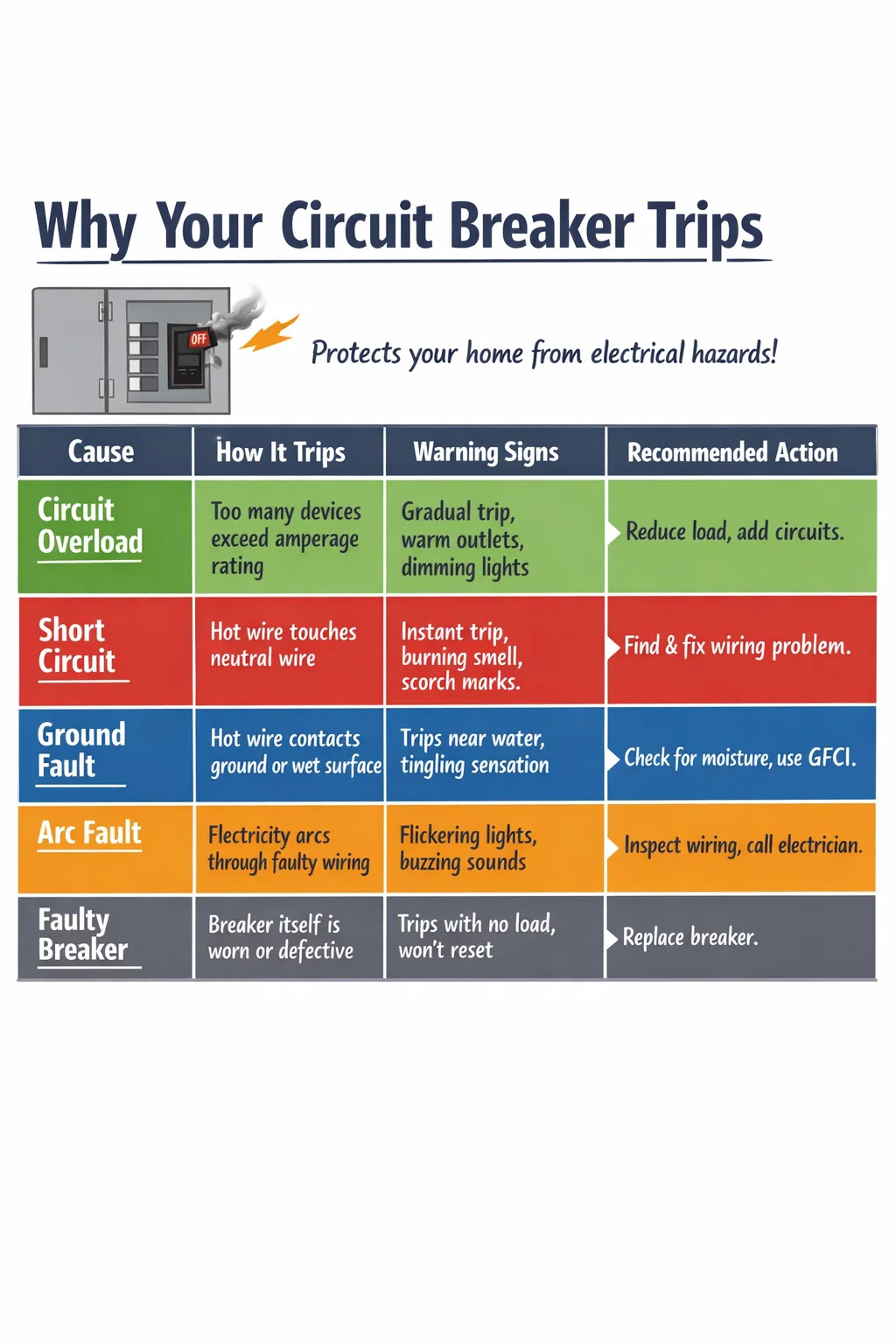
- 7 Comparing the Main Causes at a Glance
- 8 High-Draw Appliances and Dedicated Circuits
- 9 How Age and Wiring Type Affect Breaker Performance
- 10 Step-by-Step: What to Do When Your Circuit Breaker Trips
- 11 When to Call a Licensed Electrician
- 12 Preventive Measures to Reduce Breaker Trips
The Short Answer: Why Your Circuit Breaker Trips
A circuit breaker trips when it detects a condition that could damage your wiring or cause a fire. The three most common causes are circuit overloads, short circuits, and ground faults. Less frequently, an aging or faulty breaker itself is the culprit. Understanding which of these is happening in your home determines whether you need a quick fix or a licensed electrician.
Circuit breakers are designed to be the weakest link in your electrical system — intentionally. When too much current flows through a circuit, the breaker interrupts power before heat builds up in the wires. This protects your home from electrical fires, which the National Fire Protection Association (NFPA) estimates cause approximately 46,700 home fires per year in the United States alone. Knowing why your breaker trips puts you in control of that protection.
Circuit Overload: The Number One Reason Breakers Trip
A circuit overload occurs when more electrical current is drawn through a circuit than it is rated to handle. Every circuit in your home is assigned a maximum amperage — typically 15 amps or 20 amps for standard household circuits. When the total load of all devices running on that circuit exceeds its capacity, the breaker trips to prevent the wiring from overheating.
A concrete example: a 15-amp circuit can safely handle about 1,800 watts continuously (15A × 120V = 1,800W). If you plug a 1,200-watt space heater, a 600-watt microwave, and a laptop charger into the same circuit, you have already exceeded that limit. The breaker will trip, often within seconds to minutes depending on how severe the overload is.
Common Devices That Cause Overloads
- Space heaters (typically 750–1,500 watts)
- Hair dryers (1,200–1,875 watts)
- Window air conditioners (500–1,500 watts)
- Vacuum cleaners (1,000–1,400 watts)
- Power tools such as circular saws and drills (up to 1,800 watts)
- Electric kettles and toasters (1,000–1,800 watts)
Overloads are most likely to happen in older homes where the electrical panel was designed for far fewer devices than modern households use. A home built in the 1960s might have circuits intended to power a few lamps and a television — not a 65-inch 4K TV, a gaming console, a soundbar, and multiple phone chargers simultaneously.
How to Fix an Overloaded Circuit
The immediate fix is straightforward: unplug some devices from the circuit before resetting the breaker. Move high-wattage appliances to different circuits in your home. For a long-term solution, consider having an electrician add a dedicated circuit for heavy-draw appliances. Kitchen appliances, in particular, should ideally each have their own 20-amp circuit.
Short Circuits: A More Serious Electrical Fault
A short circuit happens when a hot (live) wire comes into direct contact with a neutral wire, creating a path of very low resistance. This causes a sudden, massive surge of current — far more than the circuit is rated for — and the breaker trips almost instantaneously. A short circuit is more serious than a simple overload because it can cause sparks, burning smells, and even fires if the breaker fails to act quickly enough.
Short circuits often occur inside the wiring of an appliance or within the walls of your home. They can be caused by:
- Faulty or damaged appliance cords where insulation has worn away
- Loose wire connections at outlets, switches, or junction boxes
- Rodent damage — mice and rats frequently chew through wire insulation
- Aged wiring in older homes where insulation has become brittle and cracked
- Water intrusion into electrical boxes or outlets
- Nails or screws accidentally driven through walls into hidden wiring
Identifying a Short Circuit vs. an Overload
The key difference in identifying these two causes is timing and smell. An overload usually takes a little time to trip the breaker — the circuit heats up gradually. A short circuit trips the breaker instantly, often accompanied by a burning smell, visible scorch marks around outlets or plugs, or a popping sound. If you notice any of these signs, do not simply reset the breaker. Investigate the source or call a licensed electrician before restoring power to that circuit.
To isolate a short circuit, unplug every device connected to the tripped circuit, then reset the breaker. If it holds, plug devices back in one at a time. If the breaker trips again when you plug in a specific device, that appliance likely has an internal short and should be repaired or replaced. If the breaker trips even with nothing plugged in, the short is in the fixed wiring of the wall, and you need a professional inspection.
Ground Faults: A Hidden Hazard in Wet Areas
A ground fault is similar to a short circuit, but instead of the hot wire touching the neutral wire, it touches the ground wire or a grounded part of the system — such as a metal electrical box, a metal pipe, or a wet surface. Ground faults are particularly dangerous in bathrooms, kitchens, garages, and outdoor areas because water dramatically lowers electrical resistance, making the human body a potential path for current to flow.
The U.S. Consumer Product Safety Commission (CPSC) estimates that ground faults are responsible for about 300 electrocution deaths per year in the United States. This is precisely why building codes have required GFCI (Ground Fault Circuit Interrupter) outlets and breakers in wet areas since the 1970s. A GFCI device monitors the current balance between the hot and neutral wires and trips in as little as 1/40th of a second when it detects even a tiny imbalance of 4–6 milliamps — far faster than a standard circuit breaker.
Where Ground Faults Commonly Occur
- Bathrooms — particularly near sinks and bathtubs
- Kitchens — outlets close to sinks and countertops
- Garages and workshops with concrete floors
- Outdoor outlets exposed to rain and moisture
- Unfinished basements and crawl spaces
- Around swimming pools and hot tubs
If a GFCI outlet or breaker repeatedly trips in a specific location, do not tape over the test button or replace it with a standard outlet. The repeated tripping is a warning that moisture or a fault is present. Investigate and correct the source of moisture or wiring damage before restoring power.
Arc Faults: The Cause Behind Many Hidden Electrical Fires
An arc fault occurs when electricity jumps, or "arcs," across a gap in damaged or deteriorated wiring. Unlike a short circuit, an arc fault may not draw enough current to trip a standard circuit breaker — yet the heat generated by the arc is intense enough to ignite nearby materials like insulation, wood framing, or dust. The NFPA attributes approximately 51% of home electrical fires to arc faults, making them a leading cause of house fires that standard breakers cannot prevent.
Arc faults are detected and interrupted by AFCI (Arc Fault Circuit Interrupter) breakers, which are now required by the National Electrical Code (NEC) in bedrooms, living rooms, hallways, and most other living spaces in new construction. If your home has AFCI breakers and one is tripping, the likely causes include:
- Damaged extension cords or power strips
- Wiring that has been pinched under furniture or stapled too tightly
- Loose connections at outlets, switches, or the electrical panel itself
- Old wiring with cracked or brittle insulation
- Appliances with internal wiring damage, particularly older devices
AFCI breakers can occasionally produce nuisance trips — false positives caused by certain motor-driven appliances like older vacuum cleaners or treadmills. However, a persistently tripping AFCI breaker should always be investigated, not ignored.
A Worn-Out or Faulty Circuit Breaker
Circuit breakers are mechanical devices with a finite lifespan. Most manufacturers rate them for around 30 to 40 years of service under normal conditions, though the International Association of Certified Home Inspectors (InterNACHI) suggests replacing breakers after about 30 years as a precaution. Breakers in panels that experience frequent trips, high heat, or moisture may degrade faster.
A worn breaker may trip at loads well below its rating, or conversely, fail to trip when it should — the latter being far more dangerous. Signs that a breaker itself may be faulty include:
- The breaker trips repeatedly without an obvious cause or increase in load
- The breaker feels hot to the touch (mild warmth is normal; heat is not)
- Visible scorch marks or a burning smell coming from the panel
- The breaker will not stay reset — it trips again immediately after being switched back on even with nothing on the circuit
- The breaker handle feels loose or does not snap firmly into the on position
Replacing a faulty breaker is not a DIY project for most homeowners. Working inside an electrical panel involves live bus bars that carry dangerously high current even when the main breaker is off. This work should be handled by a licensed electrician.
Comparing the Main Causes at a Glance
| Cause | How It Trips | Warning Signs | Recommended Action |
|---|---|---|---|
| Circuit Overload | Too many devices exceed amperage rating | Gradual trip, warm outlets, dimming lights | Redistribute load; add dedicated circuits |
| Short Circuit | Hot wire contacts neutral wire | Instant trip, burning smell, scorch marks | Isolate faulty device or call electrician |
| Ground Fault | Hot wire contacts ground or wet surface | Trip near water sources, tingling sensation | Inspect for moisture; use GFCI protection |
| Arc Fault | Electricity arcs across damaged wiring | AFCI trip, flickering lights, buzzing sounds | Inspect wiring and devices; call electrician |
| Faulty Breaker | Mechanical or thermal failure in breaker | Trips with no load, hot panel, won't reset | Replace breaker — hire a licensed electrician |
High-Draw Appliances and Dedicated Circuits
One of the most overlooked contributors to chronic circuit breaker tripping is running high-demand appliances on shared circuits. Many modern appliances require — and the NEC mandates — their own dedicated circuits. Attempting to share these circuits with other loads is a reliable way to cause repeated trips.
The following appliances typically require or strongly benefit from dedicated circuits:
- Electric dryers — require a dedicated 30-amp, 240-volt circuit
- Electric ranges and ovens — typically require a 50-amp, 240-volt circuit
- Refrigerators — recommended on a dedicated 20-amp circuit to avoid tripping due to compressor startup surges
- Dishwashers — require a dedicated 20-amp circuit under most codes
- Microwave ovens — dedicated 20-amp circuit strongly recommended
- EV chargers (Level 2) — typically require a dedicated 40- to 50-amp, 240-volt circuit
- Central air conditioning units — require dedicated 240-volt circuits, typically 30–60 amps depending on unit size
- Home workshops with power tools — dedicated 20-amp circuits for each major tool
If you are adding appliances like an EV charger or a large workshop, budget for panel upgrades as well. Many homes built before the 1990s have 100-amp main service panels, which may be insufficient for modern electrical loads. Upgrading to a 200-amp or even 400-amp panel is a worthwhile investment that eliminates overloads at the source.
How Age and Wiring Type Affect Breaker Performance
The age of your home's wiring plays a significant role in how frequently your circuit breaker trips — and how much risk a trip represents. Homes built before 1970 may contain wiring that compounds tripping problems and creates serious safety hazards.
Aluminum Wiring
Between approximately 1965 and 1973, aluminum wiring was widely used in North American homes as a cheaper alternative to copper. Aluminum expands and contracts more than copper with temperature changes, causing connections to loosen over time. Loose connections create resistance, which generates heat and increases the risk of arcing. The CPSC has estimated that homes with aluminum wiring are 55 times more likely to have wire connections reach fire-hazard conditions compared to copper-wired homes. If you have aluminum wiring and experience frequent circuit breaker trips, have a licensed electrician inspect and retrofit your connections with CO/ALR-rated devices or pigtail connections using copper wire.
Knob-and-Tube Wiring
Found in homes built before roughly 1940, knob-and-tube (K&T) wiring has no ground conductor, uses cloth or rubber insulation that deteriorates with age, and was designed for electrical loads far below what modern households demand. If this type of wiring has been connected to a modern electrical panel, the breakers may trip frequently due to the wiring's inability to safely carry modern loads. In many cases, K&T wiring should be replaced entirely.
Federal Pacific Electric (FPE) and Zinsco Panels
Two specific brands of electrical panels — Federal Pacific Electric Stab-Lok and Zinsco — have been identified through independent research as potentially defective. Some FPE Stab-Lok breakers have been shown to fail to trip under overcurrent conditions, while others trip randomly at normal loads. If your home has one of these panels, replacement is strongly advisable regardless of whether you are experiencing tripping problems.
Step-by-Step: What to Do When Your Circuit Breaker Trips
When a circuit breaker trips, follow these steps methodically to identify the cause and restore power safely.
- Do not immediately reset the breaker. First, check for obvious signs of a problem — burning smell, visible sparks, scorch marks, or wet conditions near electrical equipment.
- Unplug all devices on the affected circuit before resetting. This removes load and helps identify whether the problem is in a device or in the fixed wiring.
- Locate the tripped breaker in your electrical panel. A tripped breaker will typically be in the middle position between ON and OFF, or it may have moved all the way to OFF. Some panels have breakers with a red indicator window that shows when tripped.
- Reset the breaker by pushing it firmly to the OFF position first, then pushing it back to ON. This two-step reset is necessary because the breaker must fully clear its tripped position before it can be re-energized.
- If the breaker holds, plug devices back in one at a time, waiting a moment after each one. If the breaker trips again when you plug in a specific device, that device is the likely cause.
- If the breaker trips again immediately with nothing plugged in, or will not reset at all, do not continue forcing it. The fault is in the wiring or the breaker itself — call a licensed electrician.
- If the circuit holds but trips again within hours or days, you likely have a persistent overload or an intermittent wiring fault. Document when and under what conditions the trips occur to help an electrician diagnose the issue.
When to Call a Licensed Electrician
Many overload situations can be resolved by redistributing devices yourself. However, certain situations require professional attention, and attempting DIY electrical work in these cases can create serious hazards or violate local building codes.
Contact a licensed electrician if any of the following apply:
- The breaker trips repeatedly with no obvious load increase or change
- You notice burning smells, scorch marks, or discoloration at outlets or in the panel
- The breaker trips immediately after being reset, even with nothing connected
- Multiple breakers are tripping simultaneously or in sequence
- You hear buzzing, crackling, or sizzling sounds from outlets or the panel
- Lights flicker or dim when appliances cycle on
- You have a home with aluminum wiring, knob-and-tube wiring, or an FPE/Zinsco panel
- You need to add new circuits, upgrade your panel, or install high-demand appliances like EV chargers
The cost of an electrical inspection — typically $100 to $200 for a basic service call in most areas — is a small price compared to the cost of an electrical fire or the medical bills from an electrocution injury. When in doubt, err on the side of caution and get a professional opinion.
Preventive Measures to Reduce Breaker Trips
While not every circuit breaker trip can be prevented — nor should it be, since tripping is the breaker doing its job — most recurring trips are avoidable with a few practical habits and upgrades.
Know Your Circuit Load Limits
Most 15-amp circuits can safely handle 1,440 watts continuously (80% of 1,800W, per NEC guidelines), and most 20-amp circuits can handle 1,920 watts continuously. Add up the wattage of devices you regularly run simultaneously on a circuit and compare it to this figure. If you are routinely close to the limit, it is time to redistribute or add circuits.
Avoid Daisy-Chaining Power Strips
Plugging one power strip into another — known as daisy-chaining — multiplies the number of devices on a single outlet and is a common cause of circuit overloads. It is also a fire hazard and is prohibited in commercial buildings by OSHA standards. Use only a single power strip per outlet, and choose one with a built-in circuit breaker for an added layer of protection.
Inspect Cords and Outlets Regularly
Physically inspect appliance cords at least once per year for cracks, fraying, kinks, or discoloration. Replace any cord that shows damage rather than taping over it. Check outlets for loose-fitting plugs — a plug that falls out or fits loosely suggests worn contacts that can cause arcing. Replace worn outlets promptly.
Schedule Periodic Electrical Inspections
The International Association of Electrical Inspectors (IAEI) recommends a professional electrical inspection every 10 years for homes under 40 years old, and every 5 years for older homes. Inspections catch deteriorating insulation, loose connections, and outdated equipment before they become emergencies. If you have purchased an older home, an electrical inspection should be one of your first priorities.
Upgrade to AFCI and GFCI Protection Where Missing
If your home does not have GFCI protection in bathrooms, the kitchen, garage, and outdoor areas, adding it is one of the highest-return safety investments you can make. GFCI outlets cost as little as $15 to $25 and can be installed by a competent DIYer in areas where wiring is already in place. Similarly, upgrading to AFCI breakers in living areas significantly reduces the risk of arc fault fires in older homes.
For exclusive deals and latest offers, sign up by entering your email address below.




 +86 18513032986
 FLC Center, Chaoyang District, Beijing, China
Copyright © DSJ Electrical Co., Ltd. All Rights Reserved
Power Distribution Equipment & System Manufacturer