+86 18513032986


Voltage Stabilizers Explained: Key Parameters Buyers Should Understand Before Ordering
Admin 2026-07-21Voltage problems are common in many electrical systems. In some areas, the grid voltage may be too low during peak load. In industrial plants, large motors or welding equipment can cause voltage fluctuation. In remote locations, long cable runs may create voltage drop. Sensitive equipment may not fail immediately, but unstable voltage can shorten its life and reduce performance.
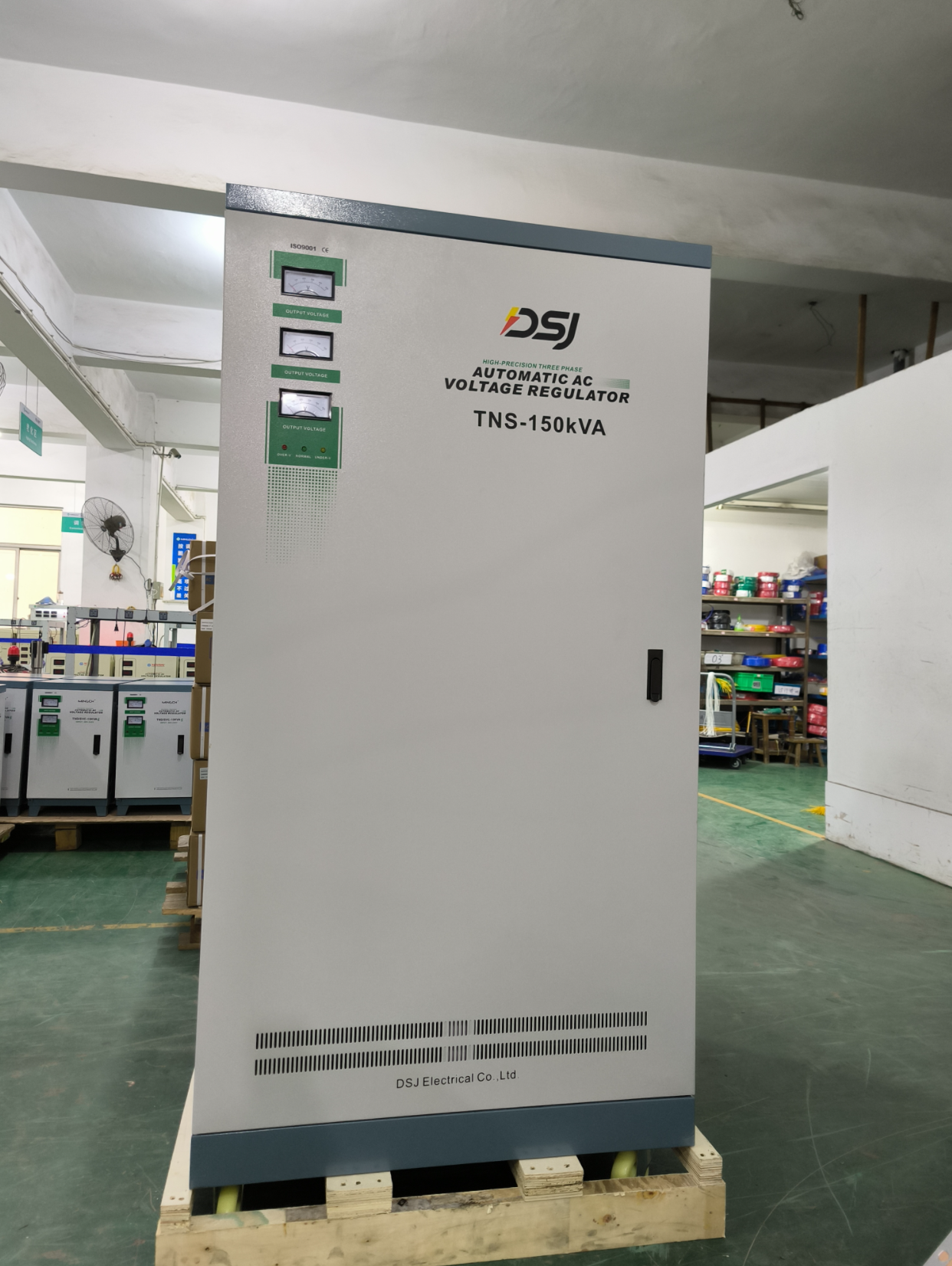
A voltage stabilizer, also called an automatic voltage regulator or AVR, is designed to keep the output voltage within a controlled range even when the input voltage changes.
What does a voltage stabilizer do?
The basic function is simple: it receives unstable input voltage and provides a more stable output voltage to the load.
For example, if the rated output voltage is 380V, the stabilizer may keep the output near 380V even when the input voltage fluctuates between a lower and higher range. This helps protect machines, control systems, motors, medical equipment, CNC equipment, elevators, communication systems, and other electrical loads.
Different stabilizers use different technologies, such as servo motor control, relay switching, electronic regulation, or contactless compensation. The best choice depends on capacity, precision, response speed, load type, and budget.
Key parameter 1: rated capacity
Capacity is usually expressed in kVA. Buyers should not select a stabilizer only based on the total rated power of the load. Starting current, motor load, power factor, overload demand, and future expansion should also be considered.
For motor loads, compressors, pumps, and elevators, starting current may be several times the running current. If the stabilizer is undersized, it may trip, overheat, or fail to regulate properly.
Key parameter 2: input voltage range
This is one of the most important parameters. The input range tells you how much voltage fluctuation the stabilizer can handle.
For example, a stabilizer may be designed for 304V to 456V input on a 380V system. Some projects require wider ranges, especially in areas with weak grids. However, a wider input range usually means larger design margin and higher cost.
The buyer should provide real site voltage data if possible. Guessing the input range is not a good idea.
Key parameter 3: output accuracy
Output accuracy describes how close the output voltage stays to the target value. Common values may be plus or minus 1%, 2%, 3%, or 5%, depending on the stabilizer type and application.
Sensitive loads require higher accuracy. General lighting or ordinary motor loads may tolerate a wider range. CNC machines, testing equipment, printing machines, and medical devices may require better regulation.
Key parameter 4: response time and correction speed
Response time is how quickly the stabilizer reacts to voltage changes. Correction speed is how fast it can bring the output back to the set range.
For slowly changing grid voltage, a servo stabilizer may work well. For fast voltage dips or sudden fluctuations, a faster electronic or contactless solution may be needed.
Key parameter 5: protection functions
A good stabilizer should not only regulate voltage. It should also protect the load and itself.
Common protection functions include:
- Over-voltage protection
- Under-voltage protection
- Overload protection
- Short-circuit protection
- Phase loss protection
- Phase sequence protection
- Over-temperature protection
- Bypass function
For industrial applications, maintenance bypass is especially useful. It allows the load to continue receiving power when the stabilizer is being serviced, depending on the system design.
Key parameter 6: efficiency and heat dissipation
Stabilizers operate continuously, so efficiency matters. Higher loss means more heat, higher energy cost, and greater cooling demand. Cabinet ventilation, fan design, temperature rise, and installation clearance should all be checked.
At DSJ Electrical, we help customers select voltage stabilizers according to actual voltage conditions and load characteristics. A stabilizer should not be chosen only by price or kVA rating. The correct solution depends on voltage range, accuracy, speed, load type, protection logic, and long-term reliability.
Stable voltage is not exciting when everything works. But when the grid is unstable, it can be the difference between smooth production and costly downtime.
For exclusive deals and latest offers, sign up by entering your email address below.



 +86 18513032986
 FLC Center, Chaoyang District, Beijing, China
Copyright © DSJ Electrical Co., Ltd. All Rights Reserved
Power Distribution Equipment & System Manufacturer