+86 18513032986


What Does a Circuit Breaker Do? Full Guide
Admin 2026-04-20Content
- 1 What a Circuit Breaker Actually Does
- 2 The Core Mechanism: How a Circuit Breaker Detects and Stops Faults
- 3 Types of Circuit Breakers and What Each One Protects Against
- 4 Amperage Ratings Explained: Why the Right Size Matters
- 5 What Causes a Circuit Breaker to Trip — and What Each Cause Means
- 6 Circuit Breakers vs. Fuses: Key Differences
- 7 How to Correctly Reset a Tripped Circuit Breaker
- 8 Signs That a Circuit Breaker Needs to Be Replaced
- 9 Circuit Breakers in Commercial and Industrial Settings
- 10 What a Circuit Breaker Cannot Do
- 11 How Often Should Circuit Breakers Be Inspected or Tested
What a Circuit Breaker Actually Does
A circuit breaker is an automatic electrical switch designed to protect a circuit from damage caused by excess current. When the current flowing through a circuit exceeds a safe level — whether from an overload, a short circuit, or a ground fault — the circuit breaker trips, interrupting the flow of electricity. Unlike a fuse, which burns out and must be replaced after a single event, a circuit breaker can be reset and reused, making it both safer and more economical for residential, commercial, and industrial electrical systems.
In plain terms: a circuit breaker stops electricity from flowing when something goes wrong. It acts as the last line of defense between your wiring and a potential fire or equipment failure. Every modern home and building is equipped with a panel — often called a breaker box or load center — housing multiple circuit breakers, each controlling a specific circuit in the building.
Understanding what a circuit breaker does is not just useful for homeowners troubleshooting a tripped breaker — it's foundational knowledge for anyone involved in construction, facility management, electrical work, or even basic home safety.
The Core Mechanism: How a Circuit Breaker Detects and Stops Faults
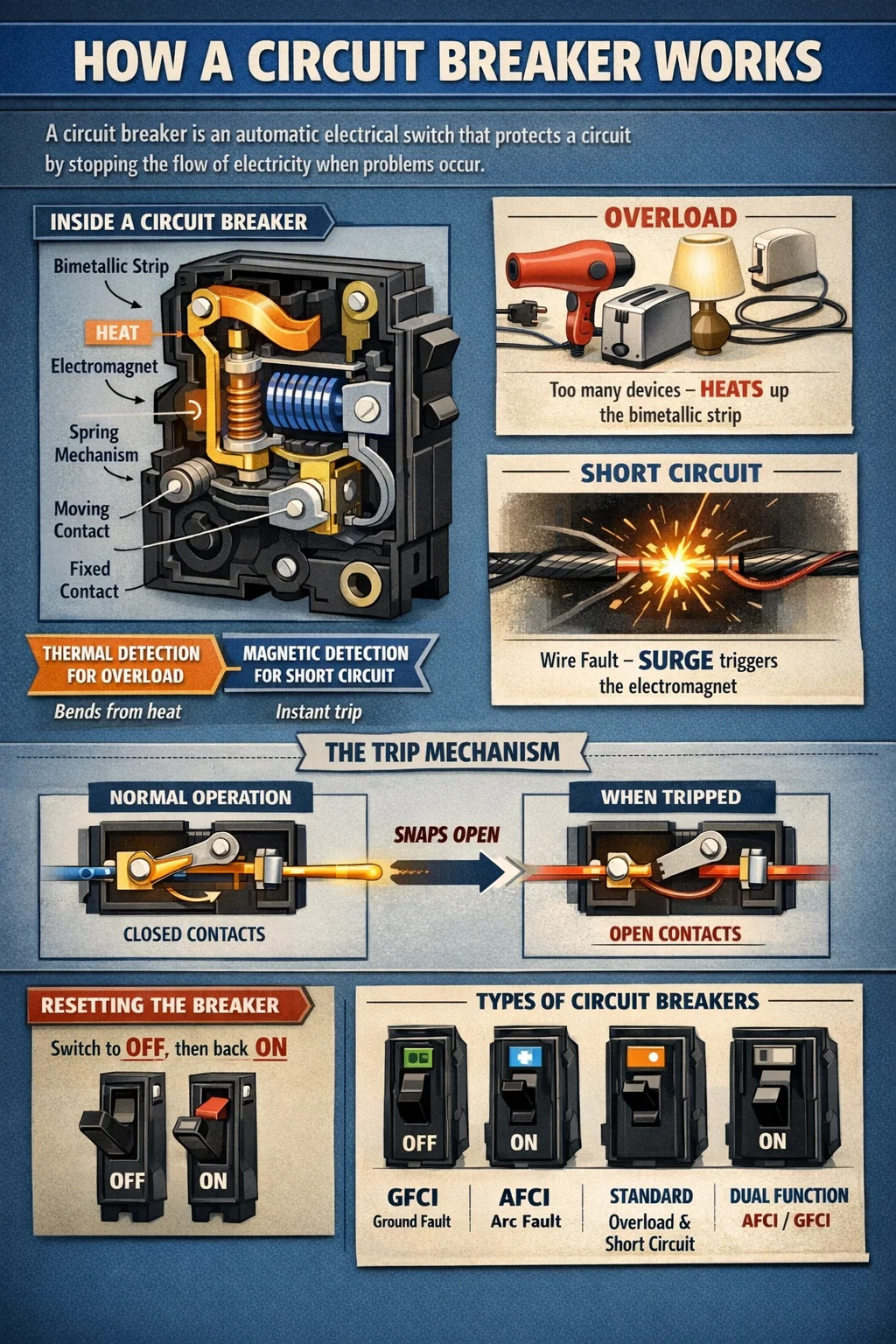
A circuit breaker operates through two primary detection mechanisms: thermal detection and magnetic detection. Most standard breakers combine both into what's known as a thermal-magnetic circuit breaker.
Thermal Detection for Overloads
Inside the breaker is a bimetallic strip — two metals bonded together that expand at different rates when heated. When a circuit draws more current than its rated capacity for a sustained period, the strip heats up, bends, and mechanically triggers the trip mechanism. This process takes a few seconds to minutes, because overloads are usually gradual. For example, plugging too many high-wattage appliances into a single 15-amp circuit causes a slow, sustained overload that the bimetallic strip will eventually respond to.
Magnetic Detection for Short Circuits
For short circuits — where a hot wire contacts a neutral or ground wire directly — the current spike is near-instantaneous and extremely large, sometimes thousands of amperes in milliseconds. The magnetic component of the breaker, an electromagnet or solenoid, responds to this sudden surge. The magnetic trip operates in under 1/60th of a second, far faster than any thermal element could react. This speed is critical because short circuits generate enormous heat almost immediately.
The Trip Mechanism and Reset
When either detection method triggers, a spring-loaded contact inside the breaker snaps open, breaking the circuit. The breaker handle moves to a middle "tripped" position. To restore power, you push the handle fully to the "off" position first, then back to "on." This resets the internal mechanism and allows current to flow again — provided the underlying fault has been resolved.
Types of Circuit Breakers and What Each One Protects Against
Not all circuit breakers are the same. Different types are designed for different risks, environments, and load requirements. Choosing the wrong type for an application isn't just a code violation — it's a safety hazard.
| Type | Primary Protection | Common Applications | NEC Requirement |
|---|---|---|---|
| Standard (Thermal-Magnetic) | Overloads & short circuits | General household circuits | All circuits |
| GFCI (Ground Fault Circuit Interrupter) | Ground faults (electrocution) | Bathrooms, kitchens, outdoors | Wet locations required |
| AFCI (Arc Fault Circuit Interrupter) | Arc faults (fire risk) | Bedrooms, living areas | Required in most living spaces |
| Dual-Function (AFCI/GFCI) | Arc faults + ground faults | Kitchens, laundry rooms | Increasingly required |
| Double-Pole | Overloads on 240V circuits | Dryers, HVAC, ranges | 240V appliances |
| High-Voltage / Industrial | Large-scale fault protection | Substations, factories | Varies by jurisdiction |
GFCI Circuit Breakers: Protecting Against Electrocution
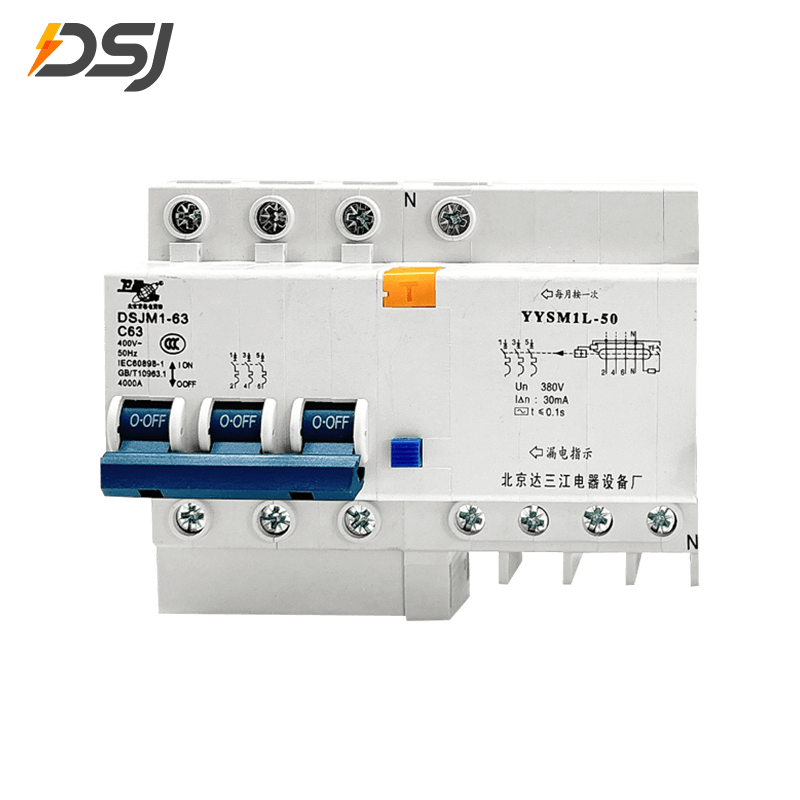
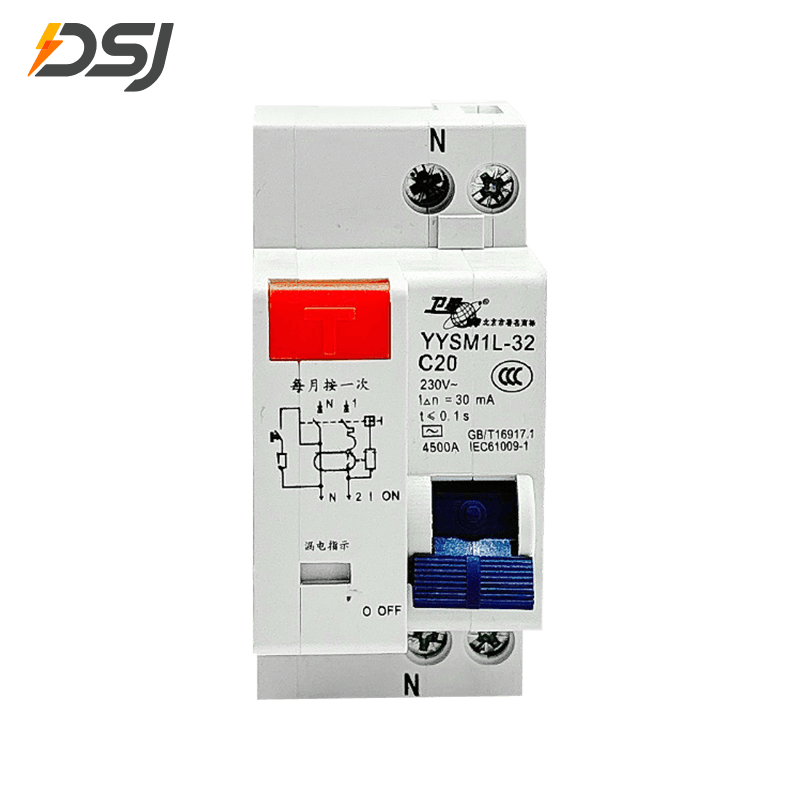
A GFCI circuit breaker monitors the difference in current between the hot and neutral wires. If that imbalance exceeds 4–6 milliamps, the breaker trips within 1/40th of a second — fast enough to prevent lethal electric shock. This is why GFCI protection is required in any location where water and electricity may be in close proximity. Even a current as small as 10 milliamps can cause involuntary muscle contractions, while 100 milliamps across the heart can be fatal.
AFCI Circuit Breakers: Preventing Electrical Fires
Arc faults occur when electricity jumps across a gap — often due to damaged insulation, loose connections, or pinched wires. An ordinary circuit breaker cannot detect these arcs because the current level may appear normal even as the arc generates temperatures exceeding 10,000°F. AFCI breakers use signal processing to identify the unique waveform signature of an arc fault and trip before a fire starts. The U.S. National Fire Protection Association (NFPA) estimates that arc faults cause approximately 30,000 home fires annually, which is a key reason the NEC has expanded AFCI requirements significantly since 1999.
Amperage Ratings Explained: Why the Right Size Matters
Every circuit breaker carries an amperage rating — the maximum continuous current it will allow before tripping. This rating must be matched carefully to the wire gauge it protects. Mismatches are one of the most dangerous DIY electrical mistakes.
- 15-amp breaker — paired with 14 AWG wire; used for general lighting and outlet circuits
- 20-amp breaker — paired with 12 AWG wire; used for kitchen countertops, bathrooms, and garage outlets
- 30-amp breaker — paired with 10 AWG wire; common for electric dryers and water heaters
- 40–50-amp breaker — paired with 8 or 6 AWG wire; used for electric ranges and large HVAC units
- 100–200-amp breaker — main service breaker protecting the entire panel
Installing an oversized breaker — say, a 30-amp breaker on 14 AWG wiring — is extremely dangerous. The wire can overheat and melt its insulation long before the breaker trips, because the breaker is rated to allow more current than the wire can safely handle. This is exactly the scenario that leads to house fires inside walls where nobody can see the problem developing.
Conversely, an undersized breaker will trip frequently under normal loads, which is frustrating but not dangerous. It simply means the circuit needs to be upgraded or loads redistributed.
What Causes a Circuit Breaker to Trip — and What Each Cause Means
When a circuit breaker trips, it's not malfunctioning — it's doing exactly what it was designed to do. But the reason behind the trip matters, because different causes require different responses.
Overloaded Circuit
This is by far the most common cause. It happens when the total electrical load on a circuit exceeds its rated capacity. For example, a 15-amp circuit can safely handle about 1,800 watts continuously (at 120V). Running a 1,500-watt space heater and a 400-watt hair dryer on the same circuit simultaneously pulls 1,900 watts — beyond the safe limit. The fix is straightforward: redistribute loads across multiple circuits or reduce the number of devices on that circuit.
Short Circuit
A short circuit is more serious. It occurs when a hot wire contacts a neutral wire, creating a path of near-zero resistance. This causes an enormous current surge — potentially thousands of amps — in milliseconds. Causes include damaged wiring, faulty appliance cords, rodent-chewed cables, and improperly installed outlets. A short circuit should never simply be reset without identifying and correcting the fault first. If the breaker trips again immediately after resetting, a short circuit is likely the cause.
Ground Fault
A ground fault happens when a hot wire contacts a grounded surface — such as a metal appliance housing or a wet floor. Unlike a short circuit, the current path through a ground fault can be relatively small, which is why a standard circuit breaker may not trip fast enough. This is precisely why GFCI protection exists and why it's required in wet locations. Ground faults are one of the leading causes of electrocution deaths in residential settings.
Arc Fault
Arc faults are often caused by loose wire connections in junction boxes, outlets, or switches, or by damaged cords that have been repeatedly bent, crimped, or pinched. The arc itself doesn't necessarily draw high current — it can smolder inside a wall for a long time before igniting insulation. Standard breakers cannot detect this; AFCI breakers can.
Aging or Faulty Breaker
Circuit breakers are rated for a certain number of operations — typically between 6,000 and 10,000 trip cycles for standard residential breakers under normal conditions. Over time, the internal components wear. A breaker that trips without apparent cause, fails to hold its position, or won't reset may simply be worn out. Breakers in panels that are 25–40 years old should be tested or proactively replaced.
Circuit Breakers vs. Fuses: Key Differences
Before circuit breakers became standard, fuses served the same protective function. A fuse contains a thin metal wire or strip that melts when excess current flows through it, permanently breaking the circuit. While fuses are reliable, they must be replaced after every fault event. Circuit breakers addressed this limitation by providing a resettable mechanism.
| Feature | Circuit Breaker | Fuse |
|---|---|---|
| Reusable after fault | Yes — reset by hand | No — must be replaced |
| Response speed | Very fast (magnetic) / Moderate (thermal) | Very fast |
| Advanced protection (AFCI/GFCI) | Available | Not available |
| Risk of bypass | Low | Higher (wrong-size fuse) |
| Long-term cost | Lower (no replacement parts) | Higher (ongoing fuse cost) |
| Common in newer construction | Universal | Rarely used |
One persistent danger with fuses is the temptation to install a higher-rated fuse when the correct size keeps blowing. Installing a 30-amp fuse in a 15-amp circuit to stop nuisance blowing is effectively removing all overcurrent protection from that circuit. Circuit breakers don't carry this same risk — you can't easily substitute a higher-rated breaker without deliberate effort, and the trip mechanism doesn't degrade with each operation the way a fuse element does.
How to Correctly Reset a Tripped Circuit Breaker
Resetting a tripped breaker is simple, but doing it correctly — and safely — requires a few specific steps that many people skip.
- Identify the tripped breaker. Look for the handle in the middle position, or a breaker that has shifted slightly from the full "on" position. Some panels have colored indicators (red or orange) that appear in a window when a breaker trips.
- Determine the cause before resetting. If the trip was caused by an obvious overload (too many devices), remove some of the load. If the trip happened immediately with nothing unusual plugged in, investigate further before resetting.
- Push the handle fully to the "off" position before pushing it back to "on." Many people skip this step and wonder why the breaker won't reset — the internal mechanism requires a full off position to re-latch.
- Push the handle firmly to the "on" position. You should feel and sometimes hear a click as the mechanism re-engages.
- If the breaker trips again immediately, do not keep resetting it. This indicates a persistent fault — a short circuit or ground fault — that must be diagnosed and corrected by a qualified electrician before power is restored.
Repeatedly resetting a breaker that keeps tripping is not just ineffective — it risks damaging the breaker's internal mechanism and, in the worst case, allows a fault condition to persist long enough to cause wire damage or fire.
Signs That a Circuit Breaker Needs to Be Replaced
A circuit breaker is not a component that needs routine replacement on a schedule, but it does wear over time. Knowing when a breaker has reached the end of its useful life can prevent both nuisance outages and serious safety events.
- The breaker trips frequently without obvious overload conditions
- The breaker won't stay in the "on" position after being reset
- The breaker feels hot to the touch during normal operation
- There is a burning smell from the panel or the breaker itself
- The breaker handle feels loose or wobbly in comparison to neighboring breakers
- Visible scorch marks or discoloration on the breaker face or surrounding panel
- The panel is 25+ years old and has never been inspected or serviced
Certain panel brands from the 1960s–1980s have documented failure histories. Federal Pacific Electric Stab-Lok panels and Zinsco (Sylvania) panels, in particular, have been associated with breakers that fail to trip during fault conditions — meaning they don't do their job when it matters most. If your home has either of these panels, a licensed electrician should evaluate them.
Circuit Breakers in Commercial and Industrial Settings
In residential settings, circuit breakers are relatively straightforward devices. In commercial and industrial environments, the complexity — and the stakes — scale dramatically.
Molded Case Circuit Breakers (MCCBs)
MCCBs are the standard in commercial applications. They offer adjustable trip settings, higher interrupt ratings, and are available in ratings from around 15 amps up to 2,500 amps. Unlike residential breakers that are fixed, an MCCB's trip threshold can often be set by a technician to match specific equipment requirements. They're used in commercial load centers, motor control centers, and industrial distribution panels.
Air Circuit Breakers (ACBs)
ACBs are used at the highest levels of commercial and industrial electrical distribution — typically for the main incoming supply in large facilities. They use air as the arc-quenching medium and are rated for currents from 800 amps to over 6,000 amps. They include sophisticated electronic trip units with adjustable long-time, short-time, instantaneous, and ground-fault protection settings.
Vacuum and SF6 Circuit Breakers
At utility and substation voltage levels — typically above 1,000 volts — specialized breakers use vacuum chambers or sulfur hexafluoride (SF6) gas to extinguish the arc that forms when contacts separate. SF6 circuit breakers can interrupt fault currents of 63,000 amps or more and are a critical component of the electrical grid. These are not serviceable by anyone other than utility professionals and specialized engineers.
What a Circuit Breaker Cannot Do
Understanding the limits of a circuit breaker is just as important as understanding what it does. Many homeowners assume that having circuit breakers means their electrical system is fully protected — but there are real gaps.
- Standard breakers cannot detect arc faults. An arc fault can exist and cause a fire without ever drawing enough current to trip a standard breaker. Only an AFCI breaker detects this.
- Standard breakers cannot protect against electrocution. A person can receive a fatal shock at current levels well below what it takes to trip a 15-amp breaker. A GFCI is required for that protection.
- A circuit breaker does not protect appliances from voltage spikes. It protects the wiring, not your electronics. Surge protectors serve a separate function.
- A circuit breaker cannot compensate for undersized wiring. If the wrong gauge wire was used in a circuit, replacing the breaker won't fix the hazard — the wiring itself must be corrected.
- A failed circuit breaker won't trip at all. A breaker that has worn past its operational life or has been damaged by a severe fault may fail to open even when it should, eliminating protection entirely.
This is why layered protection matters in electrical system design: the right breaker type for the right location, properly rated wiring, grounded outlets, GFCI protection in wet areas, AFCI protection in sleeping and living areas, and periodic inspection of the panel as a whole.
How Often Should Circuit Breakers Be Inspected or Tested
Most homeowners never test their circuit breakers — they simply assume they work until one trips. That assumption is reasonable for frequently tripped breakers that get exercised regularly, but breakers that have never been tripped in years may have internal components that are seized or corroded.
The general guidance from electrical safety organizations:
- Test GFCI breakers monthly using the test button on the breaker or the outlet. Press "Test" — the outlet should lose power. Press "Reset" — it should restore power. If it doesn't respond correctly, replace it.
- Test AFCI breakers monthly in the same way — the test button on the breaker should trip it. If it doesn't, the unit needs replacement.
- Have the entire panel inspected every 10 years by a licensed electrician, or whenever you notice signs of wear, heat, or unusual behavior.
- Exercise standard breakers annually — meaning, manually switch them off and back on to ensure the mechanism hasn't seized from disuse.
In commercial facilities, maintenance schedules are typically more rigorous. NFPA 70B (Recommended Practice for Electrical Equipment Maintenance) provides detailed guidance on inspection intervals and testing procedures for commercial and industrial electrical equipment, including breakers of all types.
For exclusive deals and latest offers, sign up by entering your email address below.




 +86 18513032986
 FLC Center, Chaoyang District, Beijing, China
Copyright © DSJ Electrical Co., Ltd. All Rights Reserved
Power Distribution Equipment & System Manufacturer