+86 18513032986


How Much Does a Circuit Breaker Cost? Full Price Guide
Admin 2026-03-16Content
- 1 How Much Does a Circuit Breaker Cost?
- 2 Circuit Breaker Cost by Type
- 3 Circuit Breaker Replacement Cost With Labor
- 4 Circuit Breaker Cost by Brand
- 5 What Affects the Price of a Circuit Breaker?
- 6 Signs Your Circuit Breaker Needs Replacing
- 7 Can You Replace a Circuit Breaker Yourself?
- 8 How to Find the Right Replacement Circuit Breaker
- 9 Circuit Breaker Cost vs. Full Panel Replacement
- 10 Ways to Save on Circuit Breaker Costs
How Much Does a Circuit Breaker Cost?
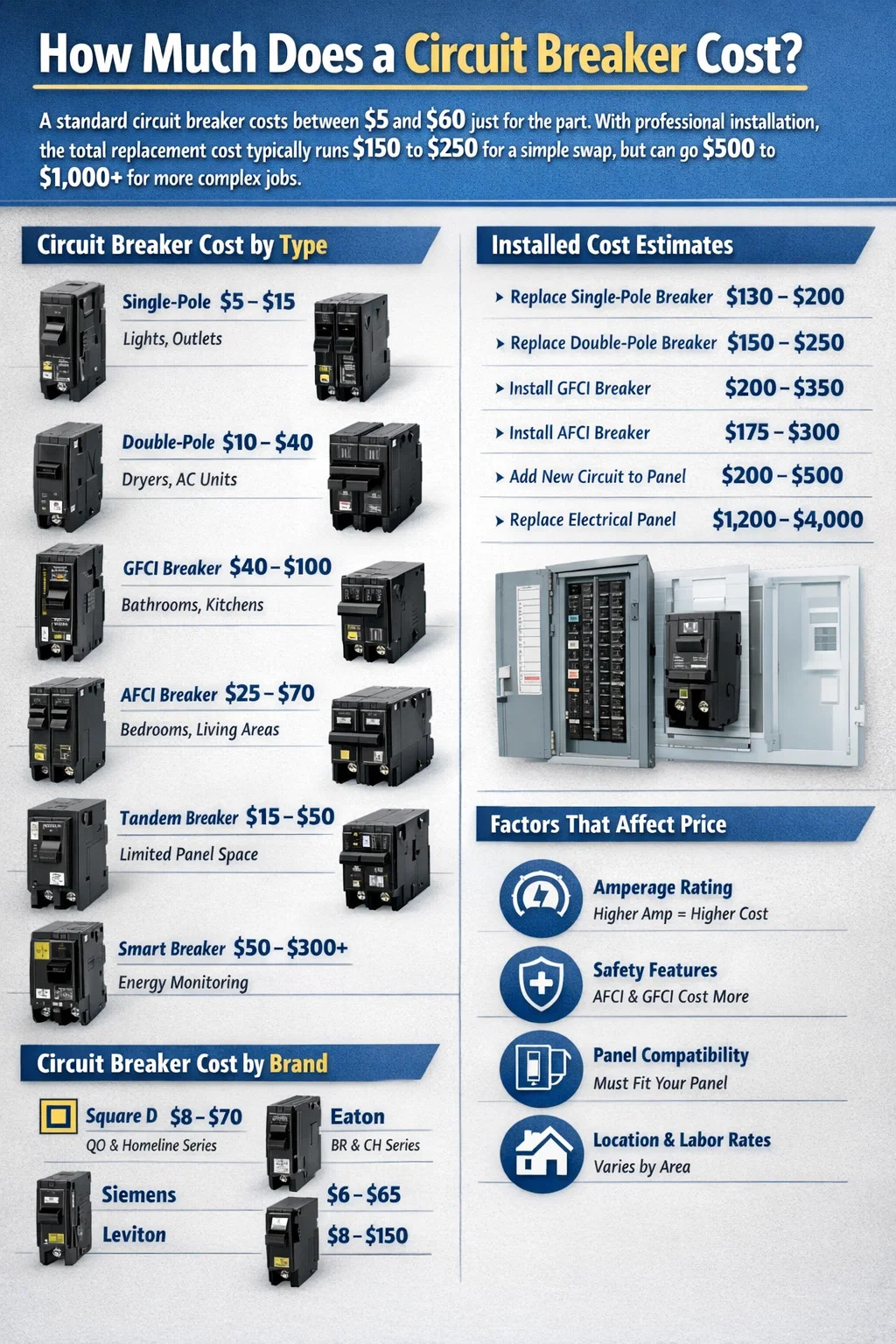
A standard circuit breaker costs between $5 and $60 for the part alone, depending on type, amperage, and brand. When you factor in professional installation labor, the total circuit breaker replacement cost typically runs $150 to $250 for a straightforward swap. More complex jobs—like adding a new breaker to a panel, upgrading to a GFCI or AFCI breaker, or replacing a whole electrical panel—can push costs to $500 or well beyond $1,000.
That wide range exists because circuit breakers are not one-size-fits-all components. The price depends on amperage rating, the number of poles, whether the breaker includes arc-fault or ground-fault protection, which brand manufactured it, and whether the unit is compatible with your existing electrical panel. Below is a complete breakdown so you know exactly what to expect before calling an electrician or heading to the hardware store.
Circuit Breaker Cost by Type
The type of circuit breaker is the single biggest factor affecting price. There are several distinct categories, each designed for different applications and safety levels.
Single-Pole Circuit Breakers
Single-pole breakers are the most common type found in residential panels. They protect 120-volt circuits and typically handle 15 or 20 amps. These are used for everyday household circuits—lights, outlets, small appliances. Expect to pay $5 to $15 per unit for a standard single-pole breaker from a reputable brand. Budget options from generic manufacturers can dip below $5, but compatibility and reliability become concerns at that price point.
Double-Pole Circuit Breakers
Double-pole breakers occupy two slots in your panel and protect 240-volt circuits. They power heavy-duty appliances like electric dryers, water heaters, central air conditioners, and electric ranges. Prices generally fall between $10 and $40, with higher amperage ratings (50A, 60A, 100A) costing more than standard 30A or 40A units.
GFCI Circuit Breakers
Ground Fault Circuit Interrupter (GFCI) breakers protect against electrical shock by detecting imbalances in current flow. They are required by code in bathrooms, kitchens, garages, outdoors, and near water sources. A GFCI circuit breaker costs $40 to $100, significantly more than a standard breaker because of the added safety electronics inside.
AFCI Circuit Breakers
Arc Fault Circuit Interrupter (AFCI) breakers detect dangerous electrical arcs that standard breakers miss—the kind that cause house fires inside walls. Modern building codes require AFCI protection in bedrooms, living rooms, and most habitable spaces in new construction. AFCI breakers typically cost $25 to $70 each. Combination AFCI/GFCI breakers, which provide both protections, run $45 to $90.
Tandem (Slim/Twin) Circuit Breakers
Tandem breakers fit two circuits into a single panel slot, useful when your panel is running low on space. They cost $15 to $50 depending on amperage and type. Not every panel accepts tandem breakers—always check your panel's label before purchasing.
Smart Circuit Breakers
Smart breakers allow remote monitoring and control via smartphone apps. They track energy usage per circuit and can shut off power remotely. These are a newer product category and carry a premium: $50 to $300 or more per breaker. Brands like Leviton and Eaton offer smart breaker options that integrate with home automation systems.
| Breaker Type | Typical Part Cost | Common Use |
|---|---|---|
| Single-Pole (15A/20A) | $5 – $15 | Lights, outlets, small appliances |
| Double-Pole (30A–100A) | $10 – $40 | Dryers, AC units, water heaters |
| GFCI Breaker | $40 – $100 | Bathrooms, kitchens, outdoors |
| AFCI Breaker | $25 – $70 | Bedrooms, living areas |
| Combination AFCI/GFCI | $45 – $90 | Mixed-use areas requiring both protections |
| Tandem Breaker | $15 – $50 | Panels with limited space |
| Smart Breaker | $50 – $300+ | Energy monitoring, remote control |
Circuit Breaker Replacement Cost With Labor
Hiring a licensed electrician to replace a circuit breaker adds labor costs on top of the part price. Most electricians charge either a flat rate for simple breaker swaps or an hourly rate for more involved work.
Electrician labor rates typically range from $50 to $120 per hour, though rates in high cost-of-living cities like San Francisco, New York, or Boston can reach $150 to $200 per hour. A straightforward breaker replacement usually takes 30 minutes to an hour, which means labor alone runs $50 to $120 for a basic job.
Many electricians charge a service call or trip fee in addition to hourly rates—commonly $75 to $150 just to show up. That means even the simplest breaker replacement job can cost $150 to $250 total when you combine parts, labor, and trip fees.
Total Installed Cost Estimates
- Replace a standard single-pole breaker: $130 – $200
- Replace a double-pole breaker: $150 – $250
- Install a new GFCI breaker: $200 – $350
- Install a new AFCI breaker: $175 – $300
- Add a new circuit breaker to panel: $200 – $500
- Replace entire electrical panel (100-amp): $1,200 – $2,500
- Replace entire electrical panel (200-amp): $1,800 – $4,000
Adding a brand-new circuit—rather than replacing an existing one—involves running new wiring through walls, which is more labor-intensive. That work can take several hours and significantly increases the total cost.
Circuit Breaker Cost by Brand
Brand matters more with circuit breakers than with many other home components. Circuit breakers are panel-specific—a Square D breaker will not necessarily fit in an Eaton panel, and using an incompatible breaker is a code violation and safety hazard. You must match the breaker brand (or an approved equivalent) to your panel.
Square D (Schneider Electric)
Square D is one of the most widely installed brands in North America. Their QO and Homeline series are standard in millions of homes. Single-pole QO breakers cost $8 to $15, while AFCI and GFCI variants run $30 to $70. Square D is known for reliable quality and wide availability at major home improvement stores.
Eaton (Cutler-Hammer)
Eaton's BR and CH series are the other dominant residential line. Pricing is comparable to Square D: $5 to $15 for standard breakers, $30 to $80 for AFCI/GFCI models. Eaton is frequently cited by electricians for solid build quality and good availability of specialty breakers.
Siemens
Siemens breakers are priced similarly to the above brands, with standard single-pole units at $6 to $14. Their AFCI models can reach $50 to $65. Siemens panels are common in homes built in the 1990s and 2000s.
Leviton
Leviton entered the breaker market more recently and is known for their smart breaker lineup. Their standard breakers are priced competitively at $8 to $20, while their smart breakers with energy monitoring run $60 to $150 or more.
Federal Pacific and Zinsco — Avoid These
If your home has a Federal Pacific Electric (FPE) Stab-Lok panel or a Zinsco panel, replacement breakers may still be available online—but most electricians strongly recommend replacing the entire panel rather than adding to it. Both brands have well-documented failure histories, including breakers that do not trip under overload conditions, creating serious fire risks. The cost to replace those panels runs $1,500 to $3,500, but it is an investment in safety, not a luxury.
What Affects the Price of a Circuit Breaker?
Several variables push the price of a circuit breaker up or down. Understanding them helps you shop smarter and avoid overpaying or buying the wrong part.
Amperage Rating
Higher amperage breakers cost more. A 15-amp single-pole breaker might cost $7, while a 60-amp double-pole breaker for the same brand runs $25 to $35. A 100-amp main breaker can cost $50 to $150 or more depending on type.
Number of Poles
Single-pole breakers cost less than double-pole breakers of equivalent quality. Triple-pole breakers, used in commercial settings, cost significantly more—often $30 to $200 or more.
Safety Features (AFCI / GFCI)
Any breaker with built-in arc-fault or ground-fault protection costs considerably more than a standard thermal-magnetic breaker. The electronics required for these functions add manufacturing cost, which is passed to the consumer. Combination AFCI/GFCI breakers are the most expensive of the standard types.
Panel Compatibility Requirements
If your panel uses an uncommon or discontinued brand, compatible replacement breakers may be harder to find and more expensive. Older panels sometimes require breakers that are only available through specialty electrical suppliers, not standard hardware stores.
Where You Buy
Prices vary noticeably between retailers. Home Depot and Lowe's carry the most common types at competitive prices. Electrical supply houses (like Graybar or Rexel) often have better pricing on bulk purchases or specialty items. Online retailers like Amazon can offer savings, but counterfeit breakers exist in the market—always buy from authorized distributors when purchasing circuit breakers online.
Signs Your Circuit Breaker Needs Replacing
Not every tripped breaker needs replacing. A breaker that trips occasionally is doing its job. But certain signs indicate a breaker has failed or is failing and needs replacement soon.
- Breaker trips repeatedly under normal load conditions without an obvious cause like a faulty appliance
- Breaker will not reset or trips immediately after being reset
- Burning smell coming from the electrical panel
- Visible scorch marks or discoloration on the breaker or panel interior
- Breaker feels hot to the touch
- Lights flicker or dim when appliances are running on that circuit
- Breaker is more than 25–30 years old and has never been replaced
- Panel brand is known for reliability issues (Stab-Lok, Zinsco)
A failed breaker is not just an inconvenience—it is a safety issue. A breaker that no longer trips under overload conditions allows wiring to overheat, which is a leading cause of residential electrical fires.
Can You Replace a Circuit Breaker Yourself?
Technically, replacing a circuit breaker is within the skill set of a handy homeowner. Practically, it involves working inside an electrical panel where certain wires remain live even with the main breaker off—specifically, the service entrance wires coming in from the utility. Touching those wires is immediately life-threatening.
That said, many homeowners do replace individual breakers themselves, particularly when:
- They are comfortable working around electricity and understand the risks
- The replacement breaker is an exact match for the failed one
- Local codes permit homeowner electrical work (rules vary by state and municipality)
- No new wiring needs to be run
If you are adding a brand-new circuit, modifying wiring, or working with a panel you are unfamiliar with, hire a licensed electrician. The labor cost—typically $100 to $200 for a simple replacement—is genuinely worthwhile for the safety assurance and the guarantee that work meets code.
Some jurisdictions require permits for electrical panel work, even simple breaker replacements. Check with your local building department before proceeding with DIY work. Unpermitted electrical work can cause problems when selling a home or filing an insurance claim.
How to Find the Right Replacement Circuit Breaker
Buying the wrong breaker wastes money and creates hazards. Here is a simple process for identifying the correct replacement.
- Identify your panel brand and model. Open the panel door and look for a label—it usually lists the manufacturer (Square D, Eaton, Siemens, etc.) and the panel model number.
- Note the breaker's amperage. It is printed on the switch handle—15A, 20A, 30A, etc.
- Check single vs. double pole. Single-pole breakers take one slot; double-pole take two slots and have a wider body.
- Check for AFCI or GFCI markings. If the existing breaker has a test button, it is a GFCI or AFCI unit—replacement must be the same type.
- Look up the panel's approved breaker list. The inside panel door often lists which breaker series are approved for use with that specific panel. Use only approved types.
- Take the old breaker to the store if possible. Matching it physically is the most reliable way to confirm compatibility.
Circuit Breaker Cost vs. Full Panel Replacement
Sometimes replacing individual breakers is a short-term fix when the real problem is an aging or undersized panel. A 100-amp panel in an older home may not handle the electrical demands of modern appliances, electric vehicle chargers, or home additions.
Upgrading from a 100-amp to a 200-amp service panel typically costs $2,000 to $4,500 installed, including the new panel, breakers, and any necessary service entrance upgrades. While that sounds steep, consider that:
- A 200-amp panel adds significant value when selling a home
- It is required in most jurisdictions before installing an EV charger or solar system
- It eliminates the safety risks of an old, outdated system
- Insurance companies increasingly require updated panels in homes with aging electrical systems
If your home still has a fuse box rather than a circuit breaker panel, replacement is almost certainly worth doing. Fuse boxes cannot support modern electrical loads and most insurers either refuse to cover homes with them or charge significantly higher premiums.
Ways to Save on Circuit Breaker Costs
There are a few practical ways to reduce what you spend on circuit breakers and related electrical work without cutting corners on safety.
Get Multiple Quotes
Electrician rates vary widely. Getting three quotes for the same job is standard practice and often results in savings of 20 to 30 percent. Be specific about exactly what you need done—"replace one 20-amp single-pole breaker"—so quotes are comparable.
Bundle Multiple Jobs
If you need multiple breakers replaced or other electrical work done, having it all done in a single visit eliminates multiple service call fees. The trip charge is often the most expensive part of a simple breaker job.
Buy Parts Yourself
Electricians typically mark up parts. If you can accurately identify the correct breaker and purchase it at a hardware store or electrical supply house, you can supply the part yourself and only pay the electrician for labor. Confirm with the electrician beforehand that they accept customer-supplied parts—some do not.
Avoid Emergency Calls
After-hours, weekend, and emergency service calls can cost 50 to 100 percent more than standard appointments. Unless the situation is genuinely dangerous, scheduling a regular appointment saves real money.
Check for Utility Rebates
Some utility companies offer rebates or financing for panel upgrades, especially when tied to EV charger installation or home electrification programs. Check with your local utility before starting any panel work.
For exclusive deals and latest offers, sign up by entering your email address below.



 +86 18513032986
 FLC Center, Chaoyang District, Beijing, China
Copyright © DSJ Electrical Co., Ltd. All Rights Reserved
Power Distribution Equipment & System Manufacturer