+86 18513032986


UL 891 Low-Voltage Switchboards: Evolving from the “Energy Heart” to the Intelligent Power Hub of AI Data Centers
Admin 2026-02-10Content
- 1 Introduction: AI Is Reshaping Data Center Power Infrastructure
- 2 AI Workloads and the Challenge of Ultra-High Power Density
- 3 Forward-Looking Electrical Planning: Designing for 1 MW and Beyond
- 4 Standards Alignment: UL 891 in the Era of Modular Data Centers
- 5 From Passive Equipment to Intelligent Power Systems
- 6 Enabling Intelligent Energy Coordination
- 7 Conclusion: From Energy Heart to Intelligent Energy Hub
Introduction: AI Is Reshaping Data Center Power Infrastructure
The rapid rise of artificial intelligence (AI), high-performance computing (HPC), and large-scale GPU clusters is redefining how modern data centers are designed and operated. Compared with traditional cloud or enterprise workloads, AI applications demand extreme power density, ultra-high reliability, rapid deployment, and intelligent energy management.
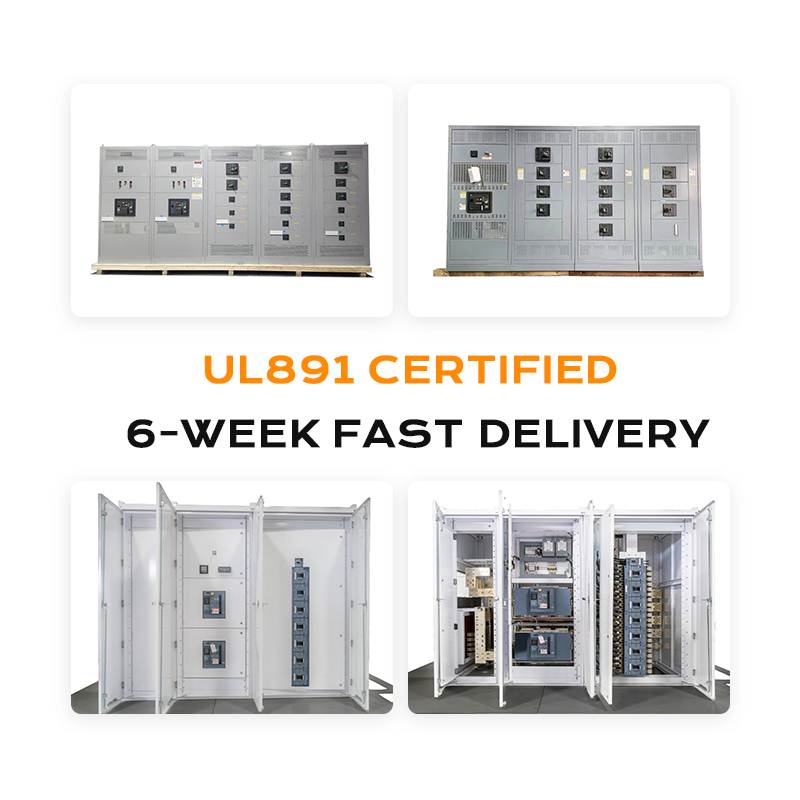
At the center of this transformation is the UL 891 low-voltage switchboards . Historically viewed as the “energy heart” of a data center—responsible for safe power distribution and fault protection—it is now evolving into an intelligent energy hub. Under AI-driven workloads, UL 891 switchboards must support higher capacities, modular architectures, and data-driven operations, while maintaining strict compliance with safety and performance standards.

AI Workloads and the Challenge of Ultra-High Power Density
AI servers dramatically increase rack-level power demand. While traditional data centers were designed around 5–10 kW per rack, modern AI deployments routinely exceed 40–60 kW, with future designs targeting 100 kW per rack or more.
This shift places unprecedented stress on low-voltage power distribution systems. UL 891 switchboards must now provide:
Higher-rated busbars with increased ampacity
Circuit breakers with greater interrupting and short-circuit withstand capabilities
Improved thermal design to manage heat from concentrated current flow
Greater tolerance for continuous high-load operation
In addition, AI data centers increasingly rely on advanced liquid-cooling technologies such as direct-to-chip cooling, immersion cooling, and high-capacity coolant distribution units (CDUs). These systems introduce new mission-critical electrical loads, including pumps, controls, and heat exchangers, which must be supplied with the same reliability as IT equipment.
As a result, the switchboard is no longer serving only IT loads—it must reliably power the entire AI compute and cooling ecosystem.
Forward-Looking Electrical Planning: Designing for 1 MW and Beyond
To accommodate rapid AI expansion, electrical planning must stay ahead of IT deployment. Many AI data centers now require 1 MW or more of reserved capacity per power distribution zone or module, even if initial utilization is significantly lower.
This trend directly affects UL 891 switchboard design and specification:
Main bus ratings of 4000 A, 5000 A, or higher
Expandable feeder sections for future growth
Space and thermal margins for additional breakers
Compatibility with higher prospective fault currents
Electrical rooms must also be designed with sufficient footprint, ventilation, and heat dissipation to support these high-capacity systems throughout their lifecycle.
At the system level, UL 891 low-voltage switchboards act as a critical interface between utility connections, UPS systems, energy storage, and downstream PDUs or RPPs, ensuring selective coordination and stable power delivery under all operating conditions.
Standards Alignment: UL 891 in the Era of Modular Data Centers
UL 891 remains the core safety and performance standard for low-voltage switchboards in North America and many global markets. It governs construction integrity, dielectric strength, temperature rise limits, grounding, and short-circuit performance—factors that are especially critical under AI-driven high-load conditions.
At the same time, AI data centers are accelerating the adoption of prefabricated and modular construction models. To support this trend, UL 891 switchboards must align with UL 2755, the standard covering prefabricated data center modules.
This alignment drives several key changes:
Modular switchboard architectures
Factory-integrated power, cooling, and IT modules
Plug-and-play electrical interfaces
Improved interoperability between multi-vendor systems
Rather than being fixed, on-site-built equipment, switchboards are becoming scalable, factory-assembled components that enable faster deployment and predictable performance.
From Passive Equipment to Intelligent Power Systems
Traditional switchboards were largely passive, relying on manual inspection and scheduled maintenance. AI data centers demand far more visibility and control.
Modern UL 891 switchboards increasingly integrate:
Intelligent electronic trip units
Embedded current, voltage, and temperature sensors
Arc-flash detection and mitigation features
Communication interfaces for real-time monitoring
When connected to data center infrastructure management (DCIM) or building management systems (BMS), these switchboards become active participants in AI-driven predictive maintenance.
Using digital twins and machine-learning analytics, operators can detect abnormal trends—such as thermal stress, load imbalance, or breaker wear—before failures occur. This shift from reactive to predictive maintenance significantly improves uptime, safety, and asset utilization.
Enabling Intelligent Energy Coordination
As AI data centers grow in scale and complexity, they increasingly function as intelligent energy nodes rather than passive power consumers. UL 891 switchboards play a central role in enabling coordination between:
Utility power supplies
UPS systems and backup generators
On-site energy storage systems
Dynamic IT and cooling loads
With appropriate monitoring and control, switchboards support advanced strategies such as load prioritization, peak shaving, and integration with microgrids or renewable energy sources. This capability improves operational resilience and contributes to better overall energy efficiency and sustainability.
Conclusion: From Energy Heart to Intelligent Energy Hub
The AI revolution is fundamentally changing data center power distribution. Under the pressure of ultra-high power density, rapid scalability, and intelligent operations, UL 891 low-voltage switchboards are evolving from simple distribution equipment into intelligent energy hubs.
By supporting higher capacities, modular deployment, advanced monitoring, and AI-driven maintenance, modern UL 891 switchboards ensure that AI data centers can operate safely, efficiently, and reliably. In this new era, they are no longer just the “energy heart” of the facility—but the central nervous system of intelligent power infrastructure.
For exclusive deals and latest offers, sign up by entering your email address below.



 +86 18513032986
 FLC Center, Chaoyang District, Beijing, China
Copyright © DSJ Electrical Co., Ltd. All Rights Reserved
Power Distribution Equipment & System Manufacturer