+86 18513032986


What is the working principle of a transformer?
Admin 2025-11-21Content
In modern power systems, the transformer is undoubtedly one of the most crucial pieces of equipment. From power plants to the sockets in our homes, the efficient transmission and distribution of electrical energy relies on it.
The foundation of a transformer: the principle of electromagnetic induction
The working principle of a transformer is primarily based on two core physical laws: Faraday's Law of Induction and Lenz's Law.
Mutual Induction
The core structure of a transformer typically includes an iron core and two or more coils wound around it, called the primary and secondary windings.
When alternating current (AC) passes through the primary winding, it generates a constantly changing magnetic flux with the same frequency as the current.
This changing magnetic flux couples to the secondary winding through the core.
According to the law of electromagnetic induction, this changing magnetic flux induces an electromotive force (voltage) in the secondary winding; this is the process of electrical energy transferring from the primary to the secondary winding.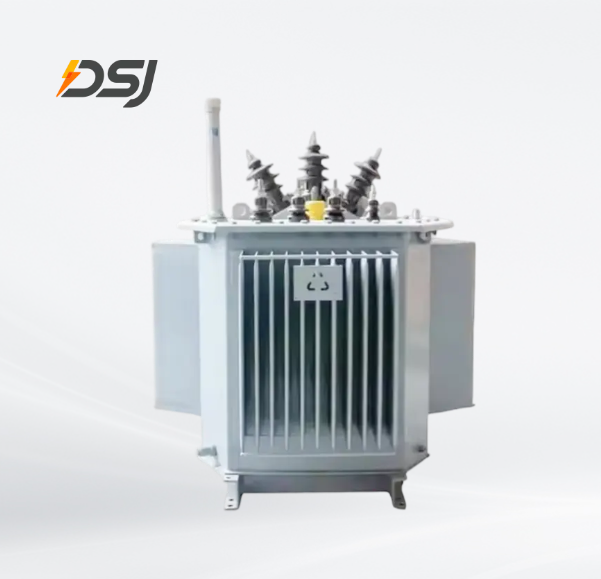
The turns ratio determines voltage change
The key to a transformer's ability to change voltage lies in the ratio of the number of turns in its primary and secondary windings; this ratio is called the turns ratio.
Relationship between turns and voltage
According to the principle of electromagnetic induction, in an ideal transformer, the voltage induced in the primary winding is directly proportional to the number of turns in the primary winding; similarly, the voltage induced in the secondary winding is directly proportional to the number of turns in the secondary winding.
Step-up operation
When the number of turns in the secondary winding is greater than the number of turns in the primary winding, the voltage induced in the secondary winding will be higher than the input voltage in the primary winding. In this case, the transformer performs a step-up function, and its turns ratio is greater than one.
Step-down operation
Conversely, when the number of turns in the secondary winding is less than the number of turns in the primary winding, the voltage induced in the secondary winding will be lower than the input voltage in the primary winding. In this case, the transformer performs a step-down function, and its turns ratio is less than one.
Therefore, by carefully designing and adjusting the number of turns in the primary and secondary windings, the magnitude of the change in the transformer's output voltage relative to the input voltage can be precisely controlled.
Key Components and Related Terms of a Transformer
Having understood the principles, let's look at some of the key components of a transformer:
- Core: Typically made of laminated high-permeability silicon steel sheets, it provides a path for magnetic flux. A good core design minimizes magnetic leakage and improves efficiency.
- Windings: These are the coils, divided into primary windings (input) and secondary windings (output), which determine the transformer's voltage transformation ratio.
- Insulation and Cooling System: Transformers generate heat during operation, requiring oil-immersed or dry-type cooling systems to dissipate heat and ensure stable operation.
- Bushings and Housing: Used for insulation and protection of internal components.
The Role of Transformers in Modern Industry
The significance of transformers lies not only in changing voltage but also in achieving efficient power transmission. High-voltage transmission (e.g., hundreds of thousands of volts) can greatly reduce power loss during transmission (loss is proportional to the square of the current), which is why step-up transformers are necessary for long-distance power transmission. Upon reaching the user, the high-voltage electricity is then stepped down to a safe and suitable voltage level (such as 220V/380V) via a step-down transformer.
A transformer is a passive electrical device that operates based on the law of electromagnetic induction. By varying the turns ratio of the primary and secondary coils, it raises or lowers the AC voltage, ensuring that electricity can be transmitted economically, safely, and efficiently from the generator to the consumer.
For exclusive deals and latest offers, sign up by entering your email address below.



 +86 18513032986
 FLC Center, Chaoyang District, Beijing, China
Copyright © DSJ Electrical Co., Ltd. All Rights Reserved
Power Distribution Equipment & System Manufacturer