+86 18513032986


From Labels to Space: A Complete Guide to Installing CSA Panel Components in Canada
Admin 2026-07-03In Canada, electrical safety is not just a slogan. It is a complete system built on strict rules like the CSA C22.1 (Canadian Electrical Code) and CSA C22.2 No. 29. The panel is the heart of power distribution. How you install its components directly affects people, property, and the power system. DSJ Electrical has years of local experience in Canadian electrical work. Below, we summarize the core installation rules into five key areas. This will help you build a clear “safety map.”
1. Components and Labels: Give Every Wire an ID
Choosing the right parts and labeling them correctly is the first step in installation. It is also the most overlooked.
For breakers, the Canadian code prefers the bolt-on type. This is more reliable than snap-on types, especially under vibration or high fault currents. When installing, odd‑ and even‑numbered breakers are usually placed on opposite sides of the panel. This left‑right layout helps match the three‑phase sequence and makes it much easier for a technician to find a circuit quickly.
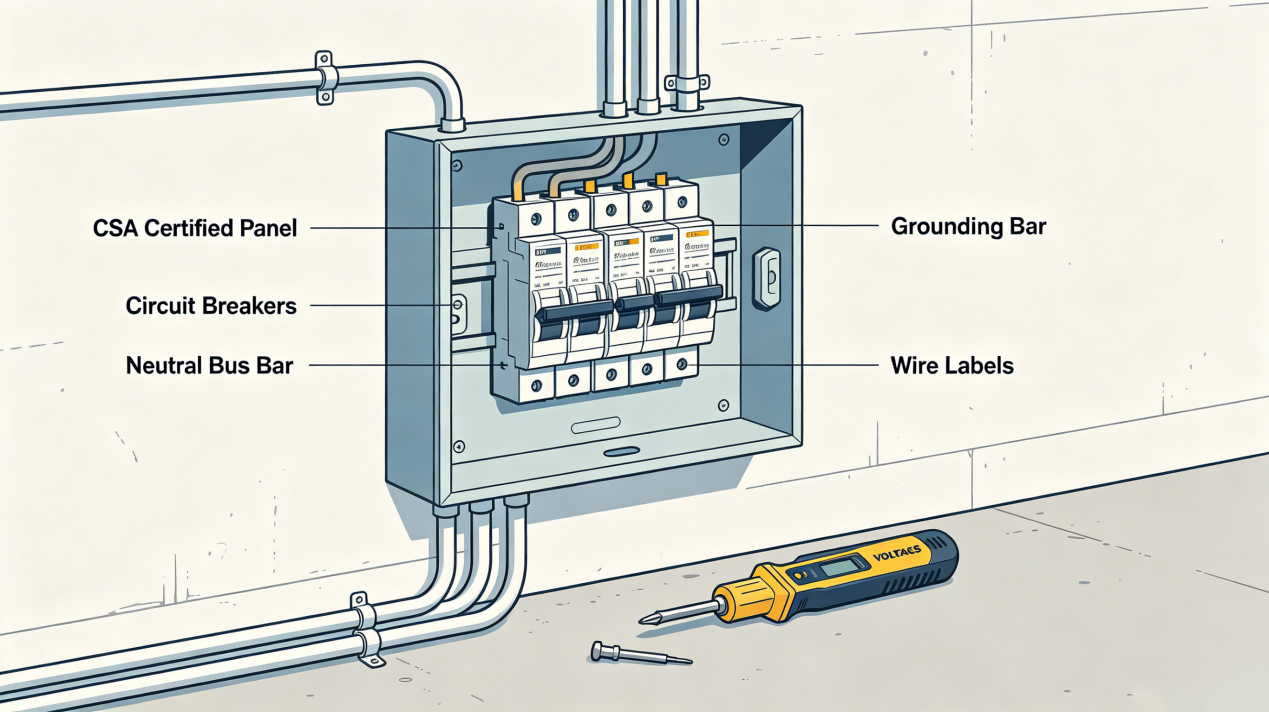
Wire labeling is very important. Both ends of every wire must have a permanent, unremovable mark (such as heat‑shrink tube or weather‑resistant tape) showing the circuit number. DSJ Electrical often finds old panels where the electrician used handwritten sticky labels. Once those get wet or rubbed, the numbers disappear. That can easily cause a mistake during repairs.
Panel labeling is also required by code. The inside of the panel door must have a complete and protected Circuit Directory. It should clearly list every breaker’s load and location. Also, the panel’s original nameplate (showing voltage, short‑circuit rating, etc.) must always be visible. Do not cover it with paint or tape.
For equipment fed by more than one power source (like a panel with dual feeds), you must put a warning label in a visible place: “Danger – Multiple Power Feeds.” Because of arc flash risks, electrical equipment usually also needs an arc flash warning label based on CSA Z462. This label reminds workers to wear the right personal protective equipment (PPE).
2. Protective Devices: Four Layers of Defense
Choosing and connecting protective devices inside the panel is key to preventing shock, fire, and equipment damage. The Canadian code requires at least four layers:
- Ground Fault Protection (GFP) – Use a Ground Fault Current Transformer (GFCT) to detect zero‑sequence current. If a ground fault happens, the system trips quickly. One very sensitive code detail is the connection between Ground and Neutral. In the main panel, the neutral is usually bonded to ground at one single point (the service neutral bond). But in sub‑panels, they must be kept separate. DSJ Electrical has seen many nuisance trips or protection failures caused by a wrong extra bond between ground and neutral.
- Ground Fault Circuit Interrupter (GFCI) – For circuits in wet areas (bathrooms, kitchen countertops, outdoors), GFCI protection is mandatory. A GFCI detects leakage current in milliamps and cuts power in milliseconds. It is the most direct way to prevent electric shock.
- Arc Fault Circuit Interrupter (AFCI) – In homes, most 15A and 20A receptacle circuits need AFCI protection. AFCI detects series or parallel arcs. These arcs often hide inside damaged wire or loose connections. A normal breaker cannot sense them, but they can easily start a fire.
- Surge Protection – This is not mandatory, but the code recommends installing a Transient Voltage Surge Suppressor (TVSS) in the panel. Canada has dry winters and thunderstorm‑prone summers. Surges from the grid or lightning can seriously damage computers, VFDs, and other sensitive electronics. A TVSS acts like a lightning rod for the whole panel.
3. Wires and Wiring Space: Let the Current “Breathe”
Crowded wires and tight bend radii inside a panel are main causes of insulation wear and local overheating. The Canadian code gives two clear numbers:
- Wire fill – At any cross‑section inside the panel, the total area of all wires (including insulation) must not exceed 40% of the space available in that section. At splices or tap points (like near terminal blocks), heat builds up, so the fill limit is tighter: 75%. DSJ Electrical warns that many non‑standard panels are built too small. Installers stuff too many wires inside. Over time, the insulation ages much faster.
- Bending space and bend radius – After a cable or wire enters the box, its minimum bend radius cannot be less than a certain multiple of the wire diameter (for example, 6–8 times for multi‑conductor power cables). Also, the box must have enough straight space so wires can reach their terminals easily. Do not force them into sharp bends. These rules may seem fussy, but they are basic protection for the wire insulation.
- Neutral connections – All neutral conductors must be firmly connected to the dedicated neutral bus bar. Never put two neutral wires under one terminal screw. Neutrals carry unbalanced current. A loose connection can create high heat and even burn up the terminal block.
4. Working Space and Maintenance: A Safe “Operation Zone” for Workers
A panel is not a piece of furniture you can push into a corner. The Canadian code has clear size requirements for the working space around a panel. The goal is to let workers operate safely and escape in an emergency.
- Working space in front – The front of the panel (where you do the work) must have at least 1 meter of clear working space. If live parts are exposed and the voltage is above 150V, this space must be larger.
- Aisle width – If you also need to work on the back or side of the panel (for example, rear‑exit cables or side‑mounted components), the clear aisle width must usually be no less than 30 inches (about 762 mm). For a panel that needs access from both sides, the aisle must be wide enough for two people to pass each other.
- Height requirement – The clear height above the working space is generally 6 feet 6 inches (about 1.98 m). This ensures a technician can stand up without hitting pipes or beams.
During project inspections, DSJ Electrical sees a common violation: the working space gets blocked by stored items or later‑added pipes. So we suggest marking the “no‑go” area on the floor with paint before the panel is installed.
5. Location and Environment: Stay Away from Danger, Close to Need
Where you put the panel decides if it will work reliably for decades.
- Mounting – The panel must be solid, vertical, and square. The tilt cannot exceed code limits (usually 1° per meter). In wet or outdoor locations, you need a weatherproof shield or an enclosure with the right IP rating (such as IP54 or higher) to keep moisture out.
- Prohibited areas – The code clearly says a panel cannot be installed in a coal bin, a closet, a bathroom, or a stairwell. Coal bins have dust explosion risks. Closets and bathrooms have high humidity and flammable materials. A stairwell can block people from escaping during a fire. The logic behind these bans is simple: the panel should be kept away from fire sources, moisture, and exit paths.
- Recommended places – The best locations are electrical rooms or mechanical rooms, placed on a base. Choose fire‑rated accessories (like firestop cable modules) based on the building’s fire code. The base height is usually 150–300 mm. This stops splashed water from the floor and gives enough space for cables to bend as they enter.
Conclusion
From a bolt‑on breaker to the one‑meter clear space in front of the panel; from one carefully made ground‑neutral bond to a visible arc flash label – every detail of CSA‑based panel installation points to one goal: verifiable safety. As a team deeply rooted in Canadian electrical work, DSJ Electrical advises all electrical professionals and facility managers: before you start a job, carefully check the latest CSA C22.1 code and any local amendments from the Authority Having Jurisdiction (AHJ). Always use components that carry a CSA or cUL certification mark. After all, following the “rules” of a panel is how you protect lives.
For exclusive deals and latest offers, sign up by entering your email address below.



 +86 18513032986
 FLC Center, Chaoyang District, Beijing, China
Copyright © DSJ Electrical Co., Ltd. All Rights Reserved
Power Distribution Equipment & System Manufacturer