+86 18513032986


How Does a Circuit Breaker Work? A Complete Guide
Admin 2026-03-23Content
- 1 How a Circuit Breaker Works: The Short Answer
- 2 The Internal Components That Make It Work
- 3 The Two Tripping Mechanisms Explained in Detail
- 4 Types of Circuit Breakers and How Each One Works Differently
- 5 How to Read a Circuit Breaker's Ratings
- 6 Why Circuit Breakers Trip: The Most Common Causes
- 7 How to Reset a Tripped Circuit Breaker Correctly
- 8 Circuit Breaker Sizing: How Amperage Is Chosen for Each Circuit
- 9 Signs a Circuit Breaker Needs to Be Replaced
- 10 Circuit Breakers vs. Fuses: Why Breakers Won
- 11 Smart and Electronic Circuit Breakers: The Next Generation
- 12 Practical Safety Reminders for Homeowners
How a Circuit Breaker Works: The Short Answer
A circuit breaker is an automatic electrical switch designed to protect a circuit from damage caused by overcurrent, overload, or short circuit. When current flowing through the circuit exceeds a safe level, the breaker trips — physically opening the circuit and cutting off power. Unlike a fuse, which must be replaced after it blows, a circuit breaker can be reset and used again. That single functional difference has made circuit breakers the standard safety device in virtually every residential, commercial, and industrial electrical panel built in the last 60 years.
The core mechanism relies on two physical principles: heat expansion from sustained overload and electromagnetic force from a sudden short circuit. Both trigger the same result — a spring-loaded contact snaps open, breaking the circuit in milliseconds. Understanding this mechanism helps homeowners make better decisions about panel upgrades, breaker sizing, and when to call an electrician.
The Internal Components That Make It Work
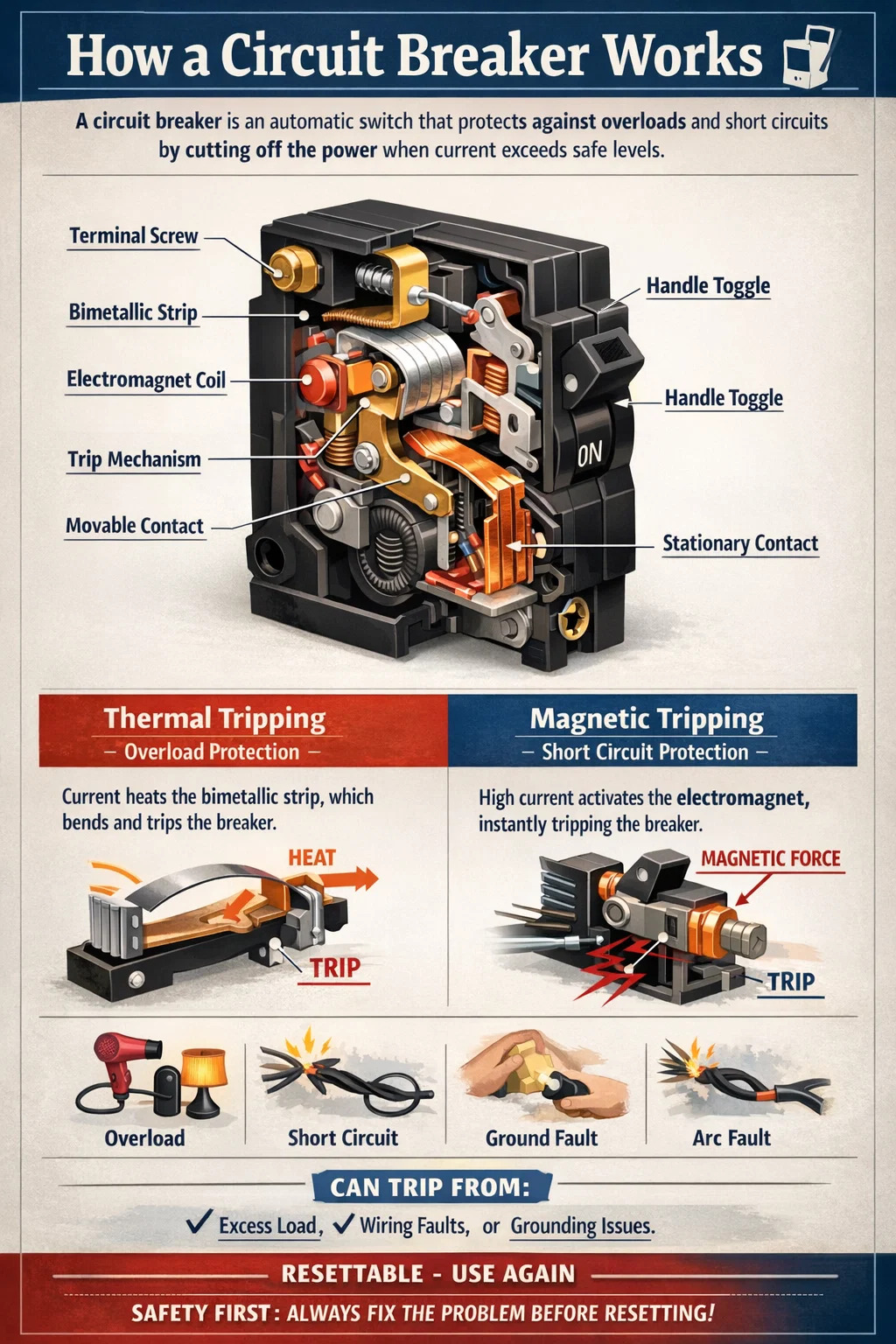
To understand how a circuit breaker operates, it helps to know what is physically inside the housing. Standard single-pole breakers contain several key components working in coordination:
- Terminal screws — where the hot wire from the circuit connects at the top, and where the bus bar connects at the bottom.
- Bimetallic strip — a layered metal strip made from two metals with different thermal expansion rates, typically steel and brass bonded together.
- Electromagnetic coil (solenoid) — a coil of wire that generates a magnetic field proportional to the current passing through it.
- Trip mechanism — a latching lever connected to a spring that holds the contacts closed under normal conditions.
- Movable and stationary contacts — two metal contact points that complete or break the circuit depending on the breaker's position.
- Arc chute — a series of metal plates that extinguish the electrical arc that forms when contacts separate under load.
- Handle toggle — the external switch used to manually reset or turn off the breaker.
Each of these parts plays a specific role. The bimetallic strip handles slow, sustained overloads. The solenoid handles sudden, high-magnitude faults. Together, they cover the full spectrum of electrical hazards a circuit might face.
The Two Tripping Mechanisms Explained in Detail
Thermal Tripping: Protecting Against Overloads
Thermal tripping is triggered when a circuit carries more current than its rated capacity over a sustained period. The bimetallic strip is in the direct path of current flow. As current increases beyond the rated amperage, the strip heats up. Because the two metals expand at different rates, the strip bends. Once the bend reaches a critical point, it pushes against the trip latch, releasing the spring-loaded contacts and opening the circuit.
The time it takes to trip is intentionally not instantaneous. A standard 20-amp breaker can tolerate 125% of its rated load (25 amps) for up to several minutes before tripping. At 200% load (40 amps), it will typically trip within about 2 minutes. This delay is intentional — motor start-up surges and brief load spikes should not trip a breaker. The thermal element provides this intelligent time-delay response.
This is why a circuit breaker trips repeatedly when you run a high-draw appliance like a space heater or hair dryer alongside other loads on the same circuit. The cumulative load exceeds the rated capacity long enough for the bimetallic strip to deflect and release the trip mechanism.
Magnetic Tripping: Protecting Against Short Circuits
Short circuits produce extremely high fault currents — often hundreds or thousands of times the breaker's rated amperage — that must be interrupted in milliseconds to prevent fire or equipment destruction. The electromagnetic coil handles this. When current spikes dramatically, the magnetic field generated by the coil becomes strong enough to rapidly pull a metal armature or plunger, which directly triggers the trip latch without waiting for thermal deflection.
A typical residential circuit breaker can interrupt a fault current in less than one-tenth of a second (under 6 cycles at 60Hz). Industrial-grade breakers rated for high short-circuit interrupting capacity (SCCR) can interrupt tens of thousands of amperes — sometimes 65,000A or more — in even shorter timeframes, protecting expensive equipment and preventing arc flash explosions.
The arc chute becomes critical during this process. When contacts separate while carrying high current, a plasma arc forms between them. The arc chute draws this arc away from the contacts, stretches it across multiple metal plates, cools it, and extinguishes it. Without this mechanism, the arc could sustain current flow even with contacts open, or damage the breaker itself.
Types of Circuit Breakers and How Each One Works Differently
Not all circuit breakers use the same operating principle. Different applications demand different protection technologies. Here is how the main types compare:
| Breaker Type | Primary Protection | Trip Mechanism | Common Application |
|---|---|---|---|
| Standard (Thermal-Magnetic) | Overload + Short Circuit | Bimetallic strip + Solenoid | General residential circuits |
| GFCI Breaker | Ground fault (as low as 4–6mA) | Current imbalance sensor | Bathrooms, kitchens, outdoors |
| AFCI Breaker | Arc faults in wiring | Electronic waveform analysis | Bedrooms, living areas (NEC required) |
| Dual-Function (AFCI+GFCI) | Arc fault + Ground fault | Both combined | Modern code-compliant installs |
| Electronic (Solid-State) | Precise overload + fault | Microprocessor-controlled | Commercial, industrial panels |
| High-Voltage (HV) Breaker | Transmission-level faults | SF6 gas, vacuum, or oil | Substations, utility grids |
GFCI Circuit Breakers
A GFCI (Ground Fault Circuit Interrupter) breaker monitors the difference in current between the hot wire and the neutral wire. Under normal conditions, these should be equal. If current is leaking to ground — through a person's body, for example — even a tiny imbalance of 4 to 6 milliamps triggers an immediate trip. This level of sensitivity is what makes GFCI protection life-saving near water sources. The U.S. National Electrical Code (NEC) mandates GFCI protection in bathrooms, kitchens, garages, basements, outdoors, and anywhere near pools or spas.
AFCI Circuit Breakers
Arc Fault Circuit Interrupter breakers address a hazard that standard breakers cannot detect: arcing faults inside walls or at connection points. Damaged insulation, loose wire connections, or pinched cords can produce electrical arcs that generate enough heat to ignite surrounding materials long before enough current flows to trip a standard breaker. AFCI breakers use onboard electronics to analyze the shape of the current waveform. The erratic, high-frequency signature of an arc fault triggers the breaker even if total current is within rated limits. The NEC has required AFCI protection in sleeping areas since 2002 and has expanded that requirement in successive code cycles to cover nearly all living spaces.
High-Voltage and Vacuum Breakers
At the utility and industrial scale, standard air-break mechanisms are inadequate. High-voltage circuit breakers use different arc-extinguishing media. Vacuum breakers separate contacts inside a sealed vacuum chamber — the absence of gas molecules prevents arc sustenance almost instantly. SF6 (sulfur hexafluoride) breakers use a pressurized gas with exceptional dielectric and arc-quenching properties, capable of handling voltages in the hundreds of kilovolts. These designs allow utility operators to protect entire transmission corridors and restore service quickly after a fault.
How to Read a Circuit Breaker's Ratings
Every circuit breaker carries a label with ratings that define its safe operating limits. Misreading or ignoring these specifications is a leading cause of panel hazards and code violations. Here is what each rating means:
- Ampere rating (e.g., 15A, 20A, 30A, 100A) — the maximum continuous current the breaker is designed to carry without tripping. By NEC standards, circuits should not be loaded beyond 80% of this value continuously. A 20A breaker should not carry more than 16A on a sustained basis.
- Voltage rating (e.g., 120V, 240V, 277V) — the maximum circuit voltage the breaker is rated to interrupt safely. Using a breaker rated for a lower voltage on a higher-voltage circuit is a serious safety hazard.
- Interrupting capacity or SCCR (e.g., 10kAIC, 22kAIC, 65kAIC) — the maximum fault current the breaker can safely interrupt. Residential panels typically see available fault currents under 10,000A, but this must be verified. Installing a breaker with insufficient interrupting capacity is a code violation and an explosion risk.
- Poles (1-pole, 2-pole, 3-pole) — defines how many hot conductors the breaker switches simultaneously. Single-pole breakers handle 120V circuits. Double-pole breakers control 240V circuits like dryers and ranges. Three-pole breakers are used in three-phase commercial and industrial systems.
- UL listing and brand compatibility — breakers must be listed for the specific panel brand and model where they are installed. A Square D QO breaker cannot be safely substituted with a generic breaker, even if it physically fits. UL 489 is the standard that governs molded case circuit breakers in North America.
Why Circuit Breakers Trip: The Most Common Causes
A tripping circuit breaker is not a nuisance — it is the system working correctly. Understanding what caused the trip determines the right response.
Circuit Overload
This is the most frequent cause in residential settings. Too many devices drawing power from a single circuit push total load beyond the breaker's rated amperage. A typical 15A, 120V circuit can deliver about 1,800 watts (15A × 120V). Running a 1,500W space heater alongside a laptop, phone charger, and lamp on that circuit consumes close to or beyond that limit. The fix is load redistribution — plug high-draw appliances into different circuits, or have an electrician add a dedicated circuit.
Short Circuit
A short circuit occurs when a hot wire makes direct contact with a neutral wire, a ground wire, or another hot wire. The resistance in the circuit path drops to near zero, causing current to surge dramatically. This typically produces a loud pop, a flash, and an immediate trip. Short circuits are often the result of damaged wiring, faulty appliance cords, or improper connections inside outlets and junction boxes. Unlike overloads, a short circuit requires investigation before restoring power — the fault must be located and corrected first.
Ground Fault
A ground fault is a type of short circuit where current travels to the grounding conductor or to earth through an unintended path — including through a person. On a GFCI-protected circuit, this trips the breaker at the milliamp level. On a standard circuit, a significant ground fault may trip the breaker through the same thermal or magnetic mechanism as any other high-current event.
Arc Fault
On AFCI-protected circuits, the breaker trips when it detects the waveform signature of an arc. This is most commonly triggered by damaged wire insulation behind walls, deteriorated wire connections in outlets or switches, or cords that have been pinched under furniture over time. Older homes with aluminum wiring or knob-and-tube wiring are particularly susceptible to arc faults.
Weak or Aging Breaker
Circuit breakers have a mechanical lifespan. Standard residential breakers are typically rated for 10,000 mechanical operations under load. Breakers that have tripped repeatedly under fault conditions may have weakened internal springs or degraded contacts, making them more prone to nuisance tripping at loads below their rated capacity. A breaker that trips at normal loads repeatedly, with no identifiable overload or fault condition, is likely due for replacement.
How to Reset a Tripped Circuit Breaker Correctly
Resetting a circuit breaker takes seconds, but doing it correctly — and safely — requires a brief process:
- Identify the tripped breaker. A tripped breaker handle sits in the middle position, between ON and OFF, or may visibly move toward the OFF side depending on the brand. Some breakers have a red indicator window that appears when tripped.
- Reduce the load on the circuit. Unplug or turn off devices on the affected circuit before resetting. If the circuit tripped due to overload and you reset it without reducing load, it will likely trip again immediately.
- Push the handle firmly to the OFF position. This is a required step. You must fully reset the spring mechanism before switching it back on. Many people skip this and wonder why the breaker won't reset.
- Switch the handle to ON. You should hear and feel a solid click as the contacts re-engage.
- If it trips again immediately, do not continue resetting it. A breaker that won't stay on after load reduction indicates a short circuit, ground fault, or failing breaker that requires professional diagnosis.
Never bypass, tape, or wedge a breaker in the ON position. That eliminates the only overcurrent protection on the circuit and creates a serious fire hazard. It is also a violation of NEC Article 240 and nearly every local electrical code.
Circuit Breaker Sizing: How Amperage Is Chosen for Each Circuit
Breaker sizing is not arbitrary — it must match the ampacity of the wire it protects, not the load it serves. The breaker's job is to protect the wiring from overheating, not to match the device plugged into it. This is a common misconception.
For example, 14 AWG copper wire is rated for 15 amps, so it must be protected by a 15A breaker. Using a 20A breaker on 14 AWG wiring allows the wire to carry up to 20 amps before the breaker trips — but the wire is only rated for 15 amps and will overheat at that load, potentially causing a fire inside the wall without tripping anything. 12 AWG wire pairs with 20A breakers, and 10 AWG wire pairs with 30A breakers.
Dedicated circuits for high-draw appliances have specific requirements:
- Electric dryers: typically 30A, 240V (10 AWG wire)
- Electric ranges and ovens: typically 40–50A, 240V (8 or 6 AWG wire)
- EV chargers (Level 2): typically 40–60A, 240V depending on charger output
- Central air conditioning units: typically 30–60A depending on tonnage and efficiency rating
- Hot water heaters: typically 30A, 240V
Oversizing a breaker (using a higher-amperage breaker than the wire is rated for) is one of the most dangerous electrical mistakes made in DIY panel work. Undersizing a breaker (using a lower-amperage breaker than necessary for the load) results in nuisance tripping but is not a safety hazard to the wiring itself.
Signs a Circuit Breaker Needs to Be Replaced
Circuit breakers are long-lasting devices, but they do wear out and fail. Recognizing the signs of a failing breaker prevents more serious electrical problems:
- Breaker trips frequently under normal loads — if a breaker trips regularly without an obvious overload, the internal mechanism may be weakened.
- Breaker will not reset — if pushing to OFF and back to ON does not restore power and there is no fault on the circuit, the breaker's internal contacts or latch may be damaged.
- Burning smell or scorch marks on the breaker or panel — this indicates overheating at the breaker or connection point and requires immediate attention.
- Physical damage or melted plastic housing — visible damage is a clear replacement indicator.
- Age of the panel — panels over 25–30 years old with original breakers may have breakers with degraded thermal elements that no longer trip reliably at rated currents.
- Warm panel or breaker to the touch — some warmth is normal, but a hot breaker or panel face indicates resistance heating from a loose connection or failing breaker.
Certain panel brands — most notably Federal Pacific Electric (FPE) Stab-Lok panels and Zinsco/Sylvania panels — have documented histories of breakers failing to trip under overload conditions. These panels have been associated with residential fires and are considered hazardous by many electricians and fire investigators. If your home has one of these panels, replacement is generally recommended regardless of apparent current function.
Circuit Breakers vs. Fuses: Why Breakers Won
Fuses perform the same fundamental overcurrent protection function as circuit breakers — when current exceeds the rating, a metal element melts and breaks the circuit. However, fuses have one critical limitation: they are single-use devices. Once a fuse blows, it must be replaced. In the era before breakers became standard, this created a common and dangerous workaround — homeowners would install a higher-rated fuse, or even a coin or piece of foil, to stop repeated fuse blowing. This overfusing practice allowed wiring to carry far more current than it was rated for, leading to house fires.
Circuit breakers eliminated this temptation. A breaker cannot be defeated by a user without physically modifying it — and it is immediately obvious when a breaker has tripped. Resetting it requires acknowledging and reducing the fault condition first. The resettable nature of breakers also makes them more practical and economical over the long term.
Fuses do retain some advantages in specific applications. They react faster than breakers in some fault conditions, they have no moving parts to wear out, and in certain industrial or automotive applications they remain the preferred protection device. But for building electrical systems, circuit breakers are now nearly universal in new construction across North America and most of Europe.
Smart and Electronic Circuit Breakers: The Next Generation
Traditional thermal-magnetic circuit breakers have remained largely unchanged in design for decades. Electronic and smart breakers represent a significant evolution in how circuits are monitored and controlled.
Electronic trip units replace the bimetallic strip and solenoid with current sensors and a microprocessor. The processor can be programmed to apply precise trip curves — adjusting overload time delays and instantaneous trip thresholds far more accurately than mechanical elements allow. This is particularly valuable in industrial settings where motors, transformers, and variable-frequency drives create complex load profiles that would cause nuisance tripping with standard breakers.
Smart circuit breakers, now appearing in residential panels from companies like Span, Leviton, and Eaton, add real-time monitoring, remote control, and energy usage data to individual circuits. These panels allow homeowners to see exactly how much power each circuit is consuming, set load limits, and remotely disconnect circuits through a smartphone app. Some smart panels can automatically shed non-critical loads during grid stress events or when running on battery backup, a function that becomes increasingly important as home battery storage and solar generation become more common.
The Span panel, for example, gives individual circuit-level control over every breaker in the panel, allows priority setting for essential loads during an outage, and tracks energy consumption per circuit in real time. This level of granularity was previously only available through expensive commercial energy management systems.
Practical Safety Reminders for Homeowners
Understanding how a circuit breaker works helps homeowners make safer, better-informed decisions. A few practical principles worth keeping in mind:
- Never replace a breaker with one of a higher amperage rating to stop tripping — investigate the cause of the overload instead.
- Always use breakers listed as compatible with your specific panel brand. The panel manufacturer's compatibility chart is the authoritative reference.
- Test GFCI breakers monthly using the built-in test button to confirm they respond correctly.
- Have an electrician perform a panel inspection every 10 years, or sooner if you notice warm breakers, discoloration, or repeated tripping.
- Label your breaker panel accurately. Unlabeled or mislabeled panels slow down emergency response and make maintenance much more hazardous.
- If a breaker trips immediately upon reset with no load connected, do not continue trying. That indicates a fault in the circuit wiring, not the breaker itself.
The circuit breaker is one of the most reliable and important safety devices in a building. It has prevented countless electrical fires and electrocution events since its widespread adoption. Knowing how it works — and respecting what it is telling you when it trips — keeps that protection doing its job effectively.
For exclusive deals and latest offers, sign up by entering your email address below.




 +86 18513032986
 FLC Center, Chaoyang District, Beijing, China
Copyright © DSJ Electrical Co., Ltd. All Rights Reserved
Power Distribution Equipment & System Manufacturer