+86 18513032986


How to Choose Between MCB and MCCB?
Admin 2026-01-31Content
When designing electrical systems or maintaining equipment, selecting the right circuit breaker is crucial for ensuring circuit safety. The choice between MCB and MCCB primarily depends on the circuit's current load, rated breaking capacity, and application scenario. Generally, MCBs (miniature circuit breakers) are suitable for residential or light commercial terminal circuits with currents below 125A and lower breaking capacity requirements; while MCCBs (molded case circuit breakers) are suitable for industrial or high-power distribution systems with currents up to 2500A, requiring adjustable tripping settings and high breaking capacity.
Key Parameter Comparison: Understanding Current Range and Breaking Capacity
Understanding the technical boundaries of these two types of circuit breaker is the first step in making the right choice.
Rated Current
MCBs typically have a rated current of no more than 125A, suitable for controlling branch circuits such as lighting and sockets. In contrast, MCCBs have a very wide rated current range, from 10A to 2500A, capable of handling the load control of the main distribution cabinet.
Rated Breaking Capacity (Icu)
This refers to the maximum short-circuit current that a circuit breaker can interrupt without damage. MCBs typically have a breaking capacity between 6kA and 10kA; while MCCBs, due to their more robust construction, can achieve breaking capacities of 25kA or even over 100kA.
Trip Function Flexibility: Fixed vs. Adjustable
In complex power systems, the accuracy of protection actions determines the continuity of the system.
MCB tripping characteristics are usually fixed (commonly B, C, and D type curves). For example, the C type curve is commonly used in ordinary household appliances, with an instantaneous trip current of 5–10 times the rated current. Users cannot fine-tune these parameters according to load changes.
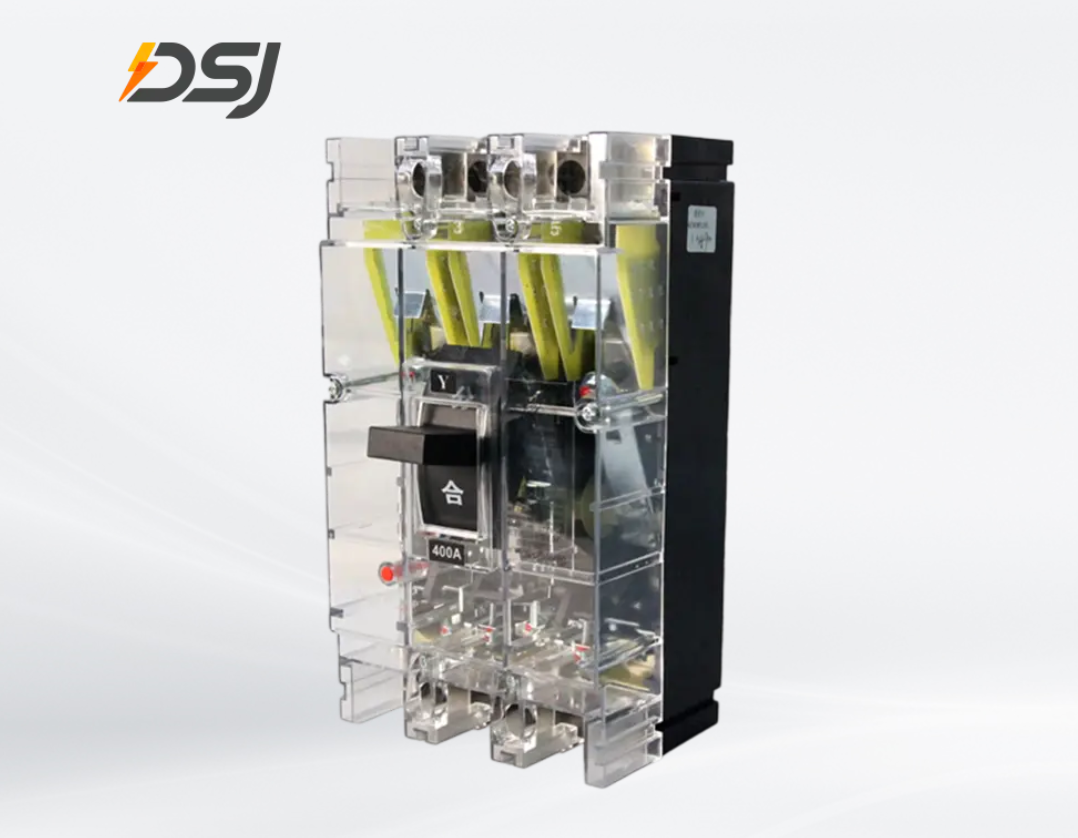
MCCBs offer more advanced protection functions. Many mid-to-high-end molded case circuit breakers are equipped with electronic trip units, allowing engineers to manually adjust the thresholds for thermal and electromagnetic protection.
Example: In an industrial compressor circuit with a high starting current, you can increase the instantaneous trip current value of the MCCB to avoid malfunctions during motor startup, which is not possible with ordinary MCBs.
Application Scenarios: Residential and Industrial Environments
Environment and application directly determine hardware selection.
Residential and Commercial Terminals: The MCB's Home Ground
In home distribution boxes or multi-level distribution boxes in office buildings, the primary responsibility of circuit breakers is to protect the final circuits. Due to the expected low short-circuit current, the compact size and convenient DIN rail mounting of MCBs make them the preferred choice. They not only save space but also cost only a fraction of the price of MCCBs of the same current rating.
Industrial and Heavy Equipment: The Role of MCCBs
In factory workshops, large data centers, or main incoming line cabinets in commercial buildings, systems need to withstand huge current surges. In this case, MCCBs are used not only for overload protection but also often as power disconnect switches. Furthermore, MCCBs support the addition of various accessories (such as shunt trip units, auxiliary contacts, and undervoltage protection), facilitating integration into automated control systems.
Cost-Effectiveness and Maintenance Cost Trade-offs
While initial purchase cost is an important consideration, the long-term value brought by safety and reliability is even more crucial.
Space Cost: If the circuit current is only 63A, choosing an MCB can save approximately 50% of the side-by-side installation space.
Ease of Replacement: Replacing a damaged MCB is extremely simple and requires no special tools.
Durability: MCCBs are typically designed for a longer mechanical and electrical life than regular MCBs, and they have a lower failure rate in industrial environments with frequent operation.
If your circuit load fluctuates frequently, or you are located in an industrial area with significant power grid fluctuations, even with currents below 100A, choosing a low-current-rated MCCB with adjustable ratings will be more cost-effective than a frequently tripping MCB.
For exclusive deals and latest offers, sign up by entering your email address below.



 +86 18513032986
 FLC Center, Chaoyang District, Beijing, China
Copyright © DSJ Electrical Co., Ltd. All Rights Reserved
Power Distribution Equipment & System Manufacturer