+86 18513032986


How to Fix an Overloaded Circuit: Step-by-Step Safety Guide
Admin 2026-05-04Content
- 1 The Short Answer: How to Fix an Overloaded Circuit Right Now
- 2 What Actually Causes a Circuit to Overload
- 3 Warning Signs Your Circuit Is Overloaded
- 4 Step-by-Step: How to Fix an Overloaded Circuit
- 4.1 Step 1 — Identify and Turn Off the Overloaded Circuit
- 4.2 Step 2 — Unplug All Devices from the Affected Circuit
- 4.3 Step 3 — Calculate the Total Load on the Circuit
- 4.4 Step 4 — Redistribute the Load
- 4.5 Step 5 — Reconnect Devices One at a Time and Test
- 4.6 Step 6 — Address the Root Cause Permanently
- 5 When to Add a Dedicated Circuit
- 6 Understanding Your Circuit Breaker: What It Does and When It Fails
- 7 Electrical Panel Upgrades: When Your Panel Is the Problem
- 8 Preventing Circuit Overloads Before They Happen
- 9 DIY Versus Calling a Licensed Electrician: Where Is the Line?
- 10 Frequently Asked Questions About Overloaded Circuits
- 10.1 Can an overloaded circuit cause a fire even if the circuit breaker does not trip?
- 10.2 Is it safe to replace a 15-amp breaker with a 20-amp breaker to stop tripping?
- 10.3 Why does my circuit breaker keep tripping even with nothing plugged in?
- 10.4 How many times can you safely reset a tripped circuit breaker?
- 10.5 What is the difference between an overloaded circuit and a short circuit?
The Short Answer: How to Fix an Overloaded Circuit Right Now
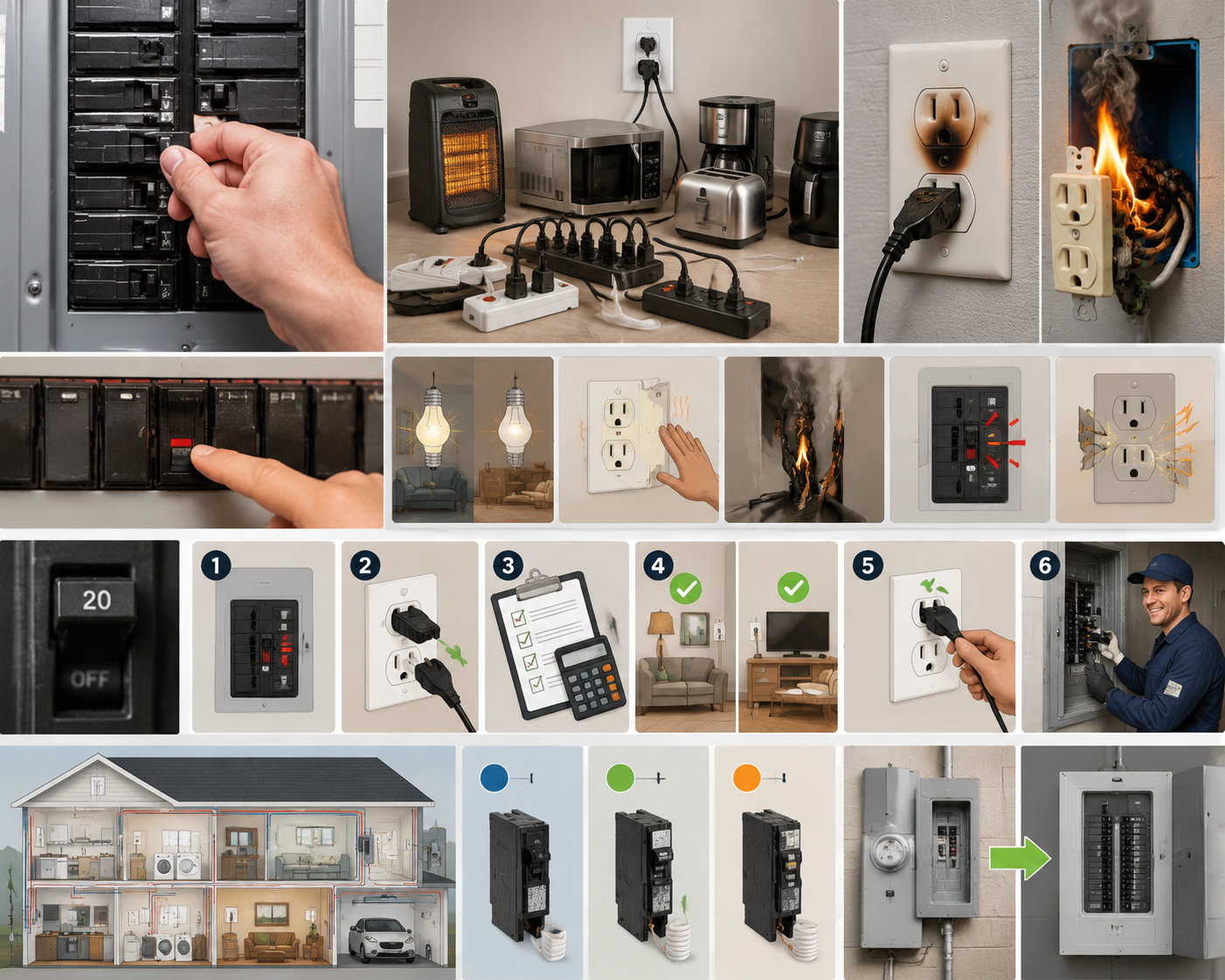
If your circuit breaker just tripped and you need power back fast, here is what to do immediately: go to your electrical panel, locate the tripped breaker (it will be in the middle or "off" position), switch it fully off, then flip it back to "on." Before you do that, unplug several devices from the affected circuit — especially anything with a heating element like a space heater, hair dryer, or toaster. Then reset the breaker. If it holds, you have reduced the load enough for now. If it trips again within seconds, stop resetting it — you have a deeper problem that a licensed electrician needs to look at.
That is the immediate fix. But resetting a tripped circuit breaker without changing anything else is just kicking the problem down the road. An overloaded circuit is one of the leading causes of residential electrical fires in the United States, accounting for roughly 47,000 home fires per year according to the Electrical Safety Foundation International (ESFI). Understanding why the overload happened and how to permanently address it is what this guide is really about.
What Actually Causes a Circuit to Overload
A circuit overload happens when the electrical demand placed on a single circuit exceeds the safe capacity that circuit was designed to handle. Every circuit in your home runs back to a circuit breaker in your electrical panel. That breaker is rated at either 15 amps or 20 amps for most standard household circuits. A 15-amp circuit can safely carry about 1,440 watts continuously (running at 80% of capacity as recommended by the National Electrical Code), while a 20-amp circuit handles about 1,920 watts.
When devices drawing more wattage than the circuit can handle are all plugged into the same circuit at the same time, the wires heat up. The circuit breaker is supposed to detect this excess current and trip — cutting power before the heat damages wires or starts a fire. That is why a tripping circuit breaker is not your enemy; it is your safety system doing exactly what it was designed to do.
Common Overload Culprits by Wattage
Many homeowners are surprised to discover how quickly wattage adds up on a single circuit. Here is a quick look at approximate power draws for common household devices:
| Appliance | Approximate Wattage | Circuit Risk Level |
|---|---|---|
| Space Heater | 1,500 W | Very High |
| Hair Dryer | 1,200–1,875 W | Very High |
| Microwave | 900–1,200 W | High |
| Air Fryer | 1,400–1,700 W | Very High |
| Window AC Unit | 900–1,440 W | High |
| Desktop Computer + Monitor | 300–600 W | Moderate |
| LED TV (55 inch) | 80–150 W | Low |
| Refrigerator | 100–400 W | Moderate (surge on startup) |
Notice how a single space heater already uses 1,500 watts — that is over 100% of the safe continuous load on a 15-amp circuit. Add a hair dryer to that same bathroom circuit and you are asking for a tripped breaker at best, and a wire fire inside your wall at worst.
Other Less Obvious Causes
Appliance overuse gets most of the blame, but there are other factors that contribute to circuit overloads that homeowners often miss:
- Old or undersized wiring: Homes built before the 1970s sometimes have wiring rated for only 60 amps total service — far below the 150–200 amps that modern homes typically need.
- Loose or corroded connections: A poor connection at a junction box or at the panel itself increases resistance, generating heat even at normal current loads.
- Outdated electrical panels: Fuse box panels and older breaker panels may not distribute electricity efficiently, making circuit overload far more likely.
- Daisy-chained power strips: Plugging a power strip into another power strip multiplies the number of devices drawing from one outlet, which traces back to a single circuit breaker.
- Faulty appliances: A malfunctioning device can draw significantly more current than its rating suggests, silently overloading a circuit even when nothing looks wrong.
Warning Signs Your Circuit Is Overloaded
Before a circuit breaker trips, or if it is failing to trip when it should, your home will usually show several warning signs. Paying attention to these symptoms can mean the difference between a quick fix and a house fire.
Flickering or Dimming Lights
When a large appliance like a refrigerator compressor or air conditioner starts up, it draws a brief surge of power — sometimes two to three times its running wattage. If the lights in the same area dim or flicker at that moment, it signals that the circuit is being pushed close to or beyond its capacity. This is especially common in kitchens and older homes where the lighting and appliances share the same circuit branch.
Warm or Discolored Outlets and Switch Plates
Outlet covers and switch plates should always be at room temperature. If they feel warm, or if you notice yellowing, browning, or scorch marks around them, the wiring behind that outlet is likely overheating. This is a serious fire warning and should not be ignored even for a day. Unplug everything from that outlet immediately and contact an electrician.
Burning or Fishy Smell
The plastic insulation around electrical wiring begins to break down and emit a distinctive burning or fishy odor when it gets too hot. If you ever smell something burning near an outlet, light fixture, or your electrical panel, treat it as an emergency. Do not try to find the source yourself — call an electrician or your fire department if you suspect active smoldering inside a wall.
Frequent Circuit Breaker Tripping
A circuit breaker that trips once in a while during a storm or a power fluctuation is doing its job. A circuit breaker that trips every time you run the microwave, or every time you turn on the bathroom exhaust fan along with the hair dryer, is telling you the circuit is consistently overloaded. Repeated tripping accelerates wear on the breaker mechanism itself — over time, an overworked breaker may fail to trip when it genuinely needs to, eliminating the one line of defense you had between your wiring and a fire.
Buzzing or Crackling Sounds
Electricity moving through wiring is silent. Buzzing, crackling, or hissing sounds from an outlet, a switch, or the electrical panel usually indicate arcing — electricity jumping across a gap caused by a loose connection or degraded insulation. This is a fire risk that should be treated urgently.
Step-by-Step: How to Fix an Overloaded Circuit
Fixing an overloaded circuit is not always complicated, but it requires a methodical approach. Rushing through it risks missing the actual cause of the problem.
Step 1 — Identify and Turn Off the Overloaded Circuit
Go to your electrical panel, which is typically a metal box mounted on a wall in the basement, garage, utility room, or hallway. Open the panel door. If a circuit breaker has tripped, it will be in the center or "tripped" position — not fully on or fully off. Flip it completely off first, then back to on. If you are not sure which breaker controls the affected area, your panel may have a labeling guide on the inside of the door. If not, a non-contact voltage tester or a circuit tracer tool can help you identify circuits without opening outlets.
Step 2 — Unplug All Devices from the Affected Circuit
Before resetting the circuit breaker, walk through the area that lost power and unplug every device from every outlet on that circuit. This is important because it prevents the circuit from immediately tripping again and helps you identify which device — or combination of devices — caused the overload in the first place.
Step 3 — Calculate the Total Load on the Circuit
This is the step most homeowners skip, and it is the most valuable one. Look at the breaker in your electrical panel — it will be labeled 15A or 20A. Multiply that number by 120 volts to get the circuit's watt capacity (15A × 120V = 1,800 watts; 20A × 120V = 2,400 watts). The National Electrical Code recommends running circuits at no more than 80% of capacity, so your safe working limit is 1,440 watts for a 15-amp circuit and 1,920 watts for a 20-amp circuit. Add up the wattage of everything that was plugged into that circuit. Appliance wattage is listed on the label on the bottom or back of the device. If the total exceeds the safe limit, you have found your problem.
Step 4 — Redistribute the Load
The simplest and most immediate solution is to move some devices to outlets on a different circuit. This sounds obvious, but many people do not realize that outlets in adjacent rooms or even on different walls of the same room can be on entirely separate circuits. Use a circuit tracer or ask an electrician to map your home's circuit layout so you know which outlets share a circuit breaker. Then intentionally spread high-wattage appliances across different circuits. A space heater and a hair dryer should never share the same 15-amp circuit — period.
Step 5 — Reconnect Devices One at a Time and Test
After resetting the circuit breaker and redistributing your highest-draw appliances, plug devices back into the circuit one at a time. Wait a few minutes between additions. If the breaker trips again after a specific device is added, that appliance may be faulty — drawing more current than its label says. Have it inspected or replaced. If the circuit holds with a reduced and balanced load, you have fixed the immediate overload.
Step 6 — Address the Root Cause Permanently
Redistributing load gives you breathing room, but it is not always a permanent solution. If your home simply does not have enough circuits to handle your electrical needs — which is extremely common in houses built before 1990 — the long-term fix involves one of the following: adding a dedicated circuit for high-draw appliances, upgrading your electrical panel to handle more circuits, or rewiring areas of the home that have outdated wiring. These tasks require a licensed electrician and, in most jurisdictions, an electrical permit.
When to Add a Dedicated Circuit
A dedicated circuit is a circuit breaker in your electrical panel that powers only one outlet or one appliance. The National Electrical Code (NEC) requires dedicated circuits for several high-draw appliances, but even appliances that are not required by code to have dedicated circuits often benefit enormously from one.
These are the appliances that should either always have, or strongly benefit from, a dedicated circuit:
- Refrigerator (NEC requires a dedicated 20-amp circuit in new construction)
- Dishwasher
- Microwave (especially built-in or over-range models drawing 1,200+ watts)
- Washing machine
- Electric dryer (typically requires a dedicated 30-amp, 240-volt circuit)
- Electric range or oven
- Level 2 EV charger (requires a dedicated 240-volt, 40–60 amp circuit)
- Central air conditioning or window AC units above 1,000 watts
- Home office workstation with multiple monitors and peripherals
Installing a dedicated circuit costs between $150 and $500 depending on the distance from the panel and local labor rates. That is a relatively small investment compared to replacing fire-damaged wiring or dealing with appliance failure caused by chronic undervoltage from a shared overloaded circuit.
Understanding Your Circuit Breaker: What It Does and When It Fails
The circuit breaker is the central safety device in your home's electrical system. Each breaker in your electrical panel is a switch that automatically cuts power to its circuit when the current flowing through it exceeds a safe threshold. Standard breakers protect against overload and short circuit. However, they do not protect against all electrical hazards — specifically, they do not detect ground faults or arc faults unless they have been designed to do so.
Types of Circuit Breakers and Their Protections
| Breaker Type | Protects Against Overload | Protects Against Arc Fault | Protects Against Ground Fault | Typical Application |
|---|---|---|---|---|
| Standard Breaker | Yes | No | No | General circuits, lighting |
| GFCI Breaker | Yes | No | Yes | Bathrooms, kitchens, outdoors |
| AFCI Breaker | Yes | Yes | No | Bedrooms, living areas |
| Dual-Function AFCI/GFCI | Yes | Yes | Yes | Whole-home protection, new construction |
If your home only has standard breakers — which is typical in homes built before 1999 — you may want to discuss upgrading to AFCI breakers with your electrician. The 2020 NEC edition requires AFCI protection on nearly all circuits in new construction, precisely because arc faults from damaged or loose wiring are a leading cause of electrical fires that standard breakers cannot detect.
When a Circuit Breaker Itself Goes Bad
Circuit breakers are electromechanical devices with a finite lifespan. Most are rated for around 30 years of service, but that assumes they are not tripping constantly. A breaker that trips and resets dozens of times a year from chronic overloading wears out much faster. Signs of a failing circuit breaker include: a breaker that trips immediately upon reset even with nothing connected to it, a breaker that no longer resets at all, or a breaker that feels hot to the touch. A faulty circuit breaker that fails to trip during an overload event is more dangerous than one that trips too frequently. Replacing a breaker costs between $150 and $250 including labor and is a job for a licensed electrician.
Electrical Panel Upgrades: When Your Panel Is the Problem
Sometimes the overloaded circuit is a symptom of a broader issue: an electrical panel that is too small or too old for the demands of a modern home. If your panel is rated for only 100 amps and you have added central air conditioning, an electric vehicle charger, a home office, and several large appliances since it was installed, you are running your entire home on infrastructure designed for a much lighter load.
The average modern home requires at least 150–200 amps of service, and homes with EV chargers, electric heat, or large workshops can benefit from 400-amp service. If your panel is rated below 150 amps, consider a panel upgrade as a long-term investment in both safety and the capacity to power your household without constant circuit overload issues.
Signs Your Panel Needs an Upgrade
- Multiple circuits are tripping regularly, not just one
- Your panel has no room for additional circuit breakers
- You have a fuse box instead of a circuit breaker panel
- Your home is more than 25 years old and has never had an electrical upgrade
- You have added major appliances, an EV charger, or a home addition since the panel was installed
- Your insurance company is flagging the electrical system as a risk
A full panel upgrade (replacing the main electrical panel and service entrance) typically costs between $1,500 and $4,000 depending on your location, the size of the new panel, and whether the utility company needs to upgrade the service line from the street. It is one of the most worthwhile home improvements you can make from a safety and resale value standpoint.
Preventing Circuit Overloads Before They Happen
Most circuit overloads are entirely preventable with a little awareness of how your home's electrical system works and some deliberate habits around how you use appliances.
Know Your Circuit Layout
Take an hour to map which outlets in your home belong to which circuit breaker. This is tedious but incredibly useful. Plug a lamp or a phone charger into an outlet, then flip breakers at the panel until the light goes out or charging stops — that outlet belongs to that breaker. Label both the panel and, if you like, the outlet plates with masking tape. Once you know the layout, you can deliberately spread heavy loads across separate circuits.
Use Power Strips With Built-In Circuit Breakers — but Understand Their Limits
Surge-protected power strips with built-in circuit breakers add an extra layer of protection at the outlet level. However, they do not change the capacity of the wall circuit behind them. Plugging a surge protector with ten outlets into a wall socket does not give you ten times the power — it still routes through the same single circuit breaker in your panel. Use them for lower-draw electronics like computers, TVs, and phone chargers. Never use them with heating appliances, refrigerators, or air conditioners.
Stagger High-Draw Appliances
If you are making breakfast and you want to run the toaster, the coffee maker, and the microwave, try running them sequentially rather than simultaneously. Staggering the use of high-wattage appliances by even a few minutes can prevent the load spike that causes a circuit breaker to trip. This is a simple habit change that costs nothing and prevents a lot of frustration.
Schedule a Periodic Electrical Inspection
A licensed electrician can assess your home's wiring, panel condition, outlet quality, and overall circuit capacity in a few hours. Industry guidance from organizations like ESFI recommends having a home electrical inspection every ten years for homes less than forty years old, and more frequently for older properties. This inspection can catch loose connections, degraded insulation, undersized wiring, and panel issues before they become hazards — and before they force you to deal with how to fix an overloaded circuit in the middle of the night.
Replace Extension Cords With Properly Wired Outlets
Extension cords are for temporary use. Using them as permanent wiring solutions — running them under rugs, threading them through walls, or stacking multiple cords together — creates fire hazards and contributes to circuit overloading. If you find yourself always needing an extension cord in a certain spot, the correct solution is to have an electrician add an outlet there instead. It typically costs $150–$300 to add a standard outlet in an existing wall.
DIY Versus Calling a Licensed Electrician: Where Is the Line?
Certain parts of fixing an overloaded circuit are entirely safe for homeowners to handle. Others are not — and the consequences of getting electrical work wrong range from code violations to fires and electrocution.
What Homeowners Can Safely Do
- Reset a tripped circuit breaker
- Unplug and redistribute devices across circuits
- Calculate load wattage and compare to circuit breaker capacity
- Map out which outlets belong to which circuit
- Replace a standard wall outlet (in most jurisdictions, with a permit in some areas)
- Test and replace GFCI outlets (the ones with test/reset buttons)
What Requires a Licensed Electrician
- Adding a new circuit or dedicated circuit breaker
- Replacing or upgrading the electrical panel
- Replacing a circuit breaker in the panel
- Rewiring any section of the home
- Upgrading the service entrance from the utility
- Installing new circuits for EV chargers, hot tubs, or HVAC equipment
- Any work inside the electrical panel itself
The electrical panel is live even when all individual circuit breakers are switched off. The main service conductors coming from the utility are still energized. Working inside a panel without proper training and equipment has killed experienced DIYers. Do not open the panel cover and work on internal components unless you are a licensed electrician.
Frequently Asked Questions About Overloaded Circuits
Can an overloaded circuit cause a fire even if the circuit breaker does not trip?
Yes. This is actually one of the most dangerous scenarios. A circuit breaker that has been weakened by years of repeated trips may fail to trip when it should. Additionally, a slow overload that heats wires gradually over hours may not trigger a breaker but still generate enough heat inside the wall cavity to ignite insulation or wood framing. This is why chronic "almost-at-capacity" loading is as dangerous as sudden extreme overloads.
Is it safe to replace a 15-amp breaker with a 20-amp breaker to stop tripping?
Almost certainly not — and this is a dangerous DIY mistake. Circuit breakers are sized to match the wiring they protect. If the wire on a circuit is 14-gauge (standard for 15-amp circuits), installing a 20-amp breaker means the wire can now be pushed beyond its safe limit without the breaker tripping to protect it. The wiring will overheat and potentially start a fire. The correct solution is to run new 12-gauge wire on a new 20-amp circuit, or to manage the load so it stays within the existing circuit's rated capacity.
Why does my circuit breaker keep tripping even with nothing plugged in?
If a circuit breaker trips immediately upon reset even with everything unplugged, the problem is likely a short circuit, a ground fault, or a failing breaker — not an overload. A short circuit occurs when a hot wire contacts a neutral or ground wire somewhere in the circuit, creating a sudden surge of current. This requires an electrician to trace and repair.
How many times can you safely reset a tripped circuit breaker?
Once you have identified and addressed the cause of the overload, resetting the breaker once is appropriate. If the breaker trips again immediately or within a short period, do not keep resetting it. Repeated resetting without fixing the underlying problem forces current through potentially damaged wiring and increases fire risk. If you cannot figure out why the breaker keeps tripping after removing load, call an electrician.
What is the difference between an overloaded circuit and a short circuit?
An overloaded circuit occurs when too many devices draw more current than the circuit can safely carry — the problem is too much demand. A short circuit occurs when electricity takes an unintended path of low resistance (usually hot to neutral or hot to ground), causing an instantaneous spike in current. Short circuits often produce a popping sound and bright flash, and the breaker trips instantly. Overloads tend to build up more gradually and the breaker trips after a few seconds to minutes of sustained excess current.
For exclusive deals and latest offers, sign up by entering your email address below.



 +86 18513032986
 FLC Center, Chaoyang District, Beijing, China
Copyright © DSJ Electrical Co., Ltd. All Rights Reserved
Power Distribution Equipment & System Manufacturer